Showing posts with label Steampunk. Show all posts

Wednesday, April 6, 2011

CROSS-POST: HOW DO I WRITE A STEAMPUNK STORY?

Dru Pagliassotti is a professor in the communications department at California Lutheran University, whose research interests include the Western reception of boys love fiction from Japan; however her interests are currently in a shift toward studying the rise of the male/male romance as a niche genre among women writers. However, Dr. Pagliassotti is better known for writing the Fantasy Steampunk tale Clockwork Heart. You can visit her website at http://drupagliassotti.com and follow her on Twitter (@drupagliassotti).

Matt's Note: This is cross-posted from STEAMED with the gracious permission of Suzanne Lazear.


HOW DO I WRITE A STEAMPUNK STORY?
by Dru Pagliassotti

Steampunk fiction consists of two elements-the steam, or gaslamp aesthetic, iconography specific to the genre — and the punk, a critical ideology orpolitical stance that satirizes, challenges, or subverts societal trends.

Each element is a necessary but not sufficient condition for labeling a story steampunk: steampunk needs both the aesthetic and the critique. Much fiction is labeled steampunk that is all steam and no punk; these works are more accurately called steampulp. So, how do you write steampunk?

THE STEAM:

The steam refers to technology that runs on steam power, of course, since classic steampunk is based or draws upon 19th century culture. Steampunk has been extended in both historical directions, however, and as often as not it mixes several historical periods in a single work, such as a 19th-century England that includes both practicing alchemists and rigid airships. Writers have the freedom to choose which technologies and settings they want to use, although the farther the historical setting is from a 19th century equivalent, the more fantastic and complicated the technologies will have to become to capture the spirit of the genre.

Steampunk’s gaslamp aesthetic reclaims the future that 19th century writers dreamed we would be living today but that never came about — a bright, shiny, elegant future of fine craftsmanship and exquisite sensibility powered by awe-inspiring, world-improving technologies. (Never mind the fact that, in the 19th century, this world wouldn’t have been meant for everybody; we’ll get to that in the punk part of this essay.)

Thus the classic 19th century gaslamp aesthetic, from A to Z, might look something like this: Airships, brass goggles, canes-corsets-cravats-chronometers, difference engines, electromagnetism, factories, gaslights, hired help, iron men, juggernauts, keypunch machines, lords and ladies, military service, newspapers, orientalism, poverty, queens, railroads, society affairs, tea, urbanization, velocipedes, workhouses, xenophobia, young anarchists, and zeppelins.

Writers can find a longer list of iconic elements at Writing.Com. Victorian technologies are overviewed in an occasional but useful series at Free the Princess and here at The Age of Steam. Descriptions of character archetypes can also be found at those two websites, Free the Princess offering lengthy discussions of each and The Age of Steam offering a more succinct list.

The challenge is that a number of these elements have become clichés — the airship pirate sporting brass goggles and long leather coat, for example; the mad scientist sporting a nifty prosthetic or two who is about to commit an act of technological or chemical mayhem; upper-class items such as watches and umbrellas that mechanically morph into lifesaving or lifetaking gadgets; the use of real people as supporting cast, such as H.G. Wells, Jules Verne, Charles Babbage, and Queen Victoria; and England, especially London, used as a setting. I have also seen enough vampires, werewolves, and faery in steampunk settings to dub them clichés, as well.

So while I’m sure it would be pathetically easy to sell a story in which H. G. Wells has been turned into a vampire and travels around the world in an airship as a spy for Queen Victoria … please, don’t.

One way to avoid clichés is to start by thinking about what the punk in the story will be, and then work backward to decide which steam elements best frame that punk.

THE PUNK:

The ’70s punk rock movement embraced individualism, anarchy, and rebellion. Disaffected youth defied the ‘truths’ drilled into them by society, distressed and repurposed material objects as a form of anti-consumerism, and created satirical, angry, and subversive works of art ranging from poetry to music to film.

This spirit became attached to the -punk suffix and applied to genres such as cyberpunk and splatterpunk. It is the same spirit that should lie at the core of the superficially more genteel and polished steampunk genre. Steampunk fiction embodies this spirit by presenting the sort of sharp, politically astute contrasts one finds between the worlds of the Eloi and Morlocks in H.G. Wells’ protosteampunk work The Time Traveller. It acts like a beautiful mahogany-and-brass screen that reflects, in its high gloss, the social failings and human weaknesses it was intended to hide.

Steampunk presents the aesthetic of a bright, shiny, elegant future of fine craftsmanship and exquisite sensibility powered by awe-inspiring, world-improving technologies … and then subverts it with the cynicism of the 20th and 21st centuries, pointing out the cracks and flaws in the Victorian dream that parallel the cracks and flaws in society today. Steampunk identifies racism, sexism, and other prejudices embedded in much scientific discourse; it describes the devastation caused by technological development carried out without a sensitivity to the environment or the indigenous culture; it highlights the problem of progress that is really a form of cultural imperialism. Even that most optimistic of steampunk genres, the steampunk romance, often presents sexual, racial, class, or religious prejudices as the obstacle the couple must overcome to achieve a happily ever after.

Steampunk writers should consider what rebellion or defiance lies at the core of their plot. In general, two types of problems are found in most steampunk fiction: (1) A material, external environmental problem caused by or solved by a technology, or (2) an ideological, internal social problem that is being strengthened by or that can be circumvented by technology. The involvement of technology is key (steam), although it can play a central or peripheral role, depending on the type of story being told.

Typical steampunk plots include the following, each of which offers an opportunity for social critique:
invention, in which Our Hero/ine is involved in creating or trying to prevent the creation of some new technology; exploration, in which OH is using technology such as an airship or other mechanical, vehicle to explore new countries, lands, or worlds; international warfare, usually involving an attempt to stop the infernal machines that threaten to wreak havoc on OH’s country; anarchy or revolution, in which case OH is either pitted against the terrorists or working with the freedom fighters and uses or opposes technology to do so; and social rebellion, in which OH is enabled by a technology to throw off cultural or social restrictions related to race, class, religion, gender, disability, sexual propriety, and the like.

Many steampunk writers situate their stories in the same places much Victorian fiction was situated — versions of London, primarily, or New York, Chicago, and San Francisco. That makes writing a little easier, because the shelves are full of writers’ guides to those cities. However, it also makes the fiction a little more predictable.

In recent years, the U.S. frontier and Australian colonies have received some attention, as have various colonial outposts in India and China. Note, however, that most of these stories are still told from the colonizers’ point of view — relatively little steampunk has been written from viewpoint of the colonized or enslaved. Yet technology did not just affect upper-class white Europeans and Americans in the 19th century. What stories haven’t been told yet? How might technologies have advantaged or disadvantaged those other groups, had history gone a little differently? If steampunk is largely set in 19th century England, what crumbling at the edges of the British Empire might reflect crumbling at the edges of today’s great economic empires? Writers seeking to extend the genre’s social critique might want to start looking at differentcountries, cultures, and ideologies for inspiration.

AND PULP?

What if you don’t want to offer social criticism with your fiction? No problem – steampulp combines the gaslamp aesthetic with pulp fictionÕs over-the-top, fast-paced adventure and excitement. It may offer occasional cultural critique, but its emphasis is on entertainment, and as often as not itÕs categorized with steampunk, anyway.

In the end, the important thing is to tell the story you want to tell. Leave it to the critics, reviewers, and academics sort out the genre’s details — your job is to write!

~Dru Pagliassotti
http://drupagliassotti.com/

Thursday, March 24, 2011

BBC America Features Steampunks!!

A few weeks back, I was invited to attend Steampunk Stylin' in Brooklyn. Unfortunately, I couldn't get away in order to make it down to the wondrous City of New York. This disappointed me because it meant I couldn't hang out with awesome Steampunk pal Ay-leen the Peacemaker or any of the other NYC area Steampunks.

It's also bothersome because BBC America filmed a story on the event, which was all kinds of cool. I mean, I could've been on the same network that I watch Doctor Who on! Awesome right?

Anyway, I have to be content with watching this video on the story instead:


STEAMPUNKS 2011 from Andy Gallacher on Vimeo.

Wednesday, November 24, 2010

The Con Report: Upstate Steampunk

It's been a few days now since Upstate Steampunk in South Carolina, so I feel more than comfortable finally writing this con report after having that time to digest the full impact of the awesome that was my very first foray into convention-going.Yes, you read that right -- I'd never been to a con before Upstate Steampunk, and it was such an amazing experience that I'm going to be heading to three more in the first six months of 2011.

My trip to S.C. started with a 4.5 hour drive from Eastern Massachusetts to Central New York to pick up my friend who agreed to act as technical assistant on the trip (that's how I was able to record my presentation). We then switched off driving the 14 hours to South Carolina. Random trivia: did you know that Pennsylvania feels like the widest state on the East Coast? This is despite the fact that Virginia takes at least 45 minutes longer to drive through on a North-South route.

But anyway, we got into South Carolina just before midnight on Friday, November 19, and promptly collapsed until the next morning when we had to wake up before 8 so we could register for the day's events. This meant that we missed the Friday night pre-registration and meet-up, but after 19 hours of driving I don't think either one of us wanted to do anything except crash.

Saturday morning was a blast though -- we registered for the day's events and then went straight to the vendor room, where I met a good number of awesome folks plying their wares. I spent some time with Jim Looper of Bitz N Pieces, who graciously demonstrated a six-shooter replica he was selling for a good chunk of change. Jim assured me the gun was non-operational, but it was still all kinds of cool to chat with him about the different pieces he had in stock. I wish I had the wherewithall to grab a picture of Jim -- he led a dueling demonstration at noon that was six different kinds of cool. Kind of sad I couldn't stick around for the entire dueling demo, but my presentation was at 1 and we had to eat lunch and do some prep work.

The time of my presentation rolled around, and I was surprised at the turnout -- many of the seats in the classroom were full. Not quite standing-room only, which would've been entertaining, but still a very respectable showing for people interested in the roots of Steampunk. The video, which will be posted later, will show you the talk I gave and hopefully you'll be able to hear the questions folks asked as well. Suffice to say, the discussion ranged far and wide once we got comfortable with each other, and didn't result in me talking at people for 90 minutes (which was something I was slightly frightened of). I did have a few technical difficulties in that I had to keep switching between my Powerpoint and a video player for my video clips -- the way we downloaded the videos meant I couldn't embed the files into the presentation itself.

Anyway, after I spoke I sat in on the very elucidating presentation by Lydia Ferguson on Captain Nemo as the new Ancient Mariner as represented by his character in Volume 1 of Alan Moore's The League of Extraordinary Gentlemen. Lydia certainly knew what she was talking about, and she did a very good job of keeping the presentation lively. Well prior to my own presentation was a discussion of the golems in Terry Pratchett's Discworld series and how they represented both the machines that drove the industrial revolution and the people who worked those machines. Janet Brennan Croft was the Golempunk presenter -- she mentioned Moist von Lipwig, one of my favorite Pratchett characters of all time in her talk, so that made me happy.

I ended up not going to a whole lot of panels, which was unfortunate because there were some dang cool topics that people were talking about. Thus is the peril of having one 90 minute talk to yourself and then being on a later hour-long panel with a group of other gents. Speaking of said panel -- with Brian K. Ladd, Maxwell Cynn, and Shane McElveen -- I have to admit that it was more interesting listening to my fellow panelists answer than talking myself. Brian, Maxwell, and Shane are all very talented and creative gents, and I was honored to be included among them. Gail Gray, our facilitator, also didn't hesitate to offer some answers to the audience members.

The other panelists and I had a whole lot of fun riffing off each other; Maxwell attended my Roots talk and I saw him nodding profusely when Gail asked if anyone had attended it. Funny anecdote: when I met Brian and his wife Megan earlier in the day, Gail was singing my praises and Brian commented that Gail was pretty much the "world's biggest cheerleader." Which of course amused me to no end. Speaking of Gail Gray and Fissure Magazine, you can purchase their Steampunk issue at http://www.shadowarcherpress.com, wherein you'll find my first published short story, "Dark Days in Bright City."

Back to the panel -- someone asked about the definition of Steampunk and if anything was excluded or not. I can't remember my exact response (which included monkeys and rockets fueled by cheese for some reason), but it amounted to the fact that Steampunk as a genre is a wide open field right now. Write what you want, and if someone likes it then someone likes it. Maxwell, Brian, and Shane had some very good advice about getting published and the potential pitfalls therein. Maxwell especially had an interesting way of putting out his first novel; he'd come up with a way to code the book into a website so at certain points you would receive emails from the characters in a sort of multimedia immersive experience.

Brian spoke at length about dealing with changes from editors, and the fact that you can break any rule on the books so long as you know why you're breaking it. And Shane made several very good points about the importance of critique; he has one trusted editor that reads all of his stuff, although he also works with a writing partner for his screenwriting. All of us agreed that crit groups are important, but even more important than that is knowing when to walk away from a crit group. Brian made a fascinating point in that he sees crit groups as being there to work -- not to socialize.

It was unfortunate that the panel was only an hour long. I had tons of fun being up there with my fellow panelists, and in fact Gail told me later that one of the attendees to that panel said he thought we were better than the authors' panel at DragonCon! You can imagine how cool that was to hear.

I ended my day with an open-ended workshop where folks talked about the stuff they made. Which is also the only time I took pictures:

A giant hammer made from foam and an old clock.
Many of the materials were purchased from Lowe's,
which was a common theme.

The creator of this map (Ed, who's not in the picture) developed this entire fantasy world
that he intends to offer to people as a fantasy setting for them to write their adventures in.

The Gatling gun was made from an old gas-powered hedge trimmer
and parts purchased at Lowe's.


My compatriot and I were more or less drained after the workshops ended at 5 on Saturday. I wandered downstairs after we'd had dinner at the Ruby Tuesday's down the street and took in some of the belly dancing. I could tell even at 8 p.m. though that I was done for the night -- didn't even stay awake to go to the Steampunk ball. This of course means that I am unfortunately unable to report who won Mr. and Mrs. Upstate Steampunk.

I can however say that driving down to Greenville was a good decision. I met a whole lot of good people there, made some awesome contacts for Flying Pen, and had an all-around great time. Now of course I'm looking forward to the conventions I'll be attending in 2011!

Friday, November 5, 2010

A Word About Historical Accuracy in Steampunk

Recently, there have been some articles and blog posts floating around lambasting Steampunk for any number of failings -- real or imagined -- that the genre seems to express. Now, there are some that I agree with, and if you've followed my Twitter back-and-forths with Paul Jessup or read his fantastic article on "The Future of Steampunk" (posted at Doctor Fantastique's Show of Wonders and Mad Hatter's Bookshelf and Book Review), then you already know that I'd love to see more non-European Steampunk kicking about.

However, one of the primary complaints that I seem to be seeing in regards to Steampunk is that it's not historically accurate. That people couldn't have possibly developed the level of technology some of the fiction evidences -- like airships, for example. Despite the fact that Henri Giffard first flew a dirigible in the 1850s, certain commenters on other blogs (not here) have insisted that airships were an invention of the 20th century and not the 19th, therefore you can't possibly have someone flying an airship on the level of the Graf Zeppelin if your timeframe is earlier than 1900.

All right I can see that argument -- Zeppelin developed his airship in 1898 to 1899, but he didn't fly it until 1900, so the point is valid. However, and here's the really, really big point that I want to make for people who dislike Steampunk on basis of it not being historically accurate enough:

Steampunk is Alternate history.

Alternate history, by its very definition, isn't 100 percent historically accurate because you're changing the historical record with your fiction. If I wanted to read a Steampunk novel that was accurate historically to the minutest of details, then I wouldn't be reading a Steampunk novel -- I'd be reading historical fiction.

So someone who complains about the lack of historical accuracy in Steampunk is missing the entire point of the stories. It's supposed to be an alternate history set in the Victorian period of world history. There is no reason for Cherie Priest, Gail Carriger, George Mann, or S.M. Peters to get their history 100% accurate because they're not writing historical novels. They're writing alternate histories with a Steampunk aesthetic that happen to be set in the 19th century.

This complaint about historical accuracy leads me of course to wonder if the people who use this tired old excuse hate the entire genre of alternate history. Do they despise the Harry Turtledove novels where aliens land in the middle of the Cold War? Or his stories where the South wins the American Civil War? Or the alternate history novels where the American Revolution never happened?

Steampunk, as I've said before, is more concerned with what could possibly happen in a real-world society with advanced steam power and mechanics introduced into the proverbial mix. If you can convince the reader that your world could possibly exist, then you've done your job as a writer. There's no reason for you to be overly concerned with complete historic accuracy -- if you're writing a story set in Victorian England, then focus on the aspects you need in order to create the flavor of the time. You're changing things anyway by including the advanced steam power and mechanics that you're already throwing into the society.

Main point? Steampunk doesn't have to be 100 percent historically accurate. Be accurate as it relates to your story. That's all you really need to be concerned about.

Thursday, September 23, 2010

Steampunk Character Type: The Adventurer

We've all seen them in fiction -- the Adventurer-Hero strikes a victorious pose with his fists on his hips and chest puffed out while the villain scrabbles away, defeated. But while this evokes images of the superheroes extant during the comic book Golden Age, and is the one that many of us can conjure up, I'm talking about Adventurers that occur in fiction significantly earlier.

Allan Quartermain. Tom Sawyer. Phileas Fogg. The Time Traveller. These are just a few of the Adventurer characters from classic fiction. As to the names from Steampunk novels? Well that's easy too -- Modo and Octavia (The Hunchback Assignments), Croggon Hainey (The Clockwork Century), Bergen (Whitechapel Gods) ... you get the picture.

We see the Adventurer a lot in Steampunk fiction, but what really typifies the character? How do we know when we've seen an Adventurer and not a regular person thrust into the story's primary plot line against their will?

The Adventurer is comfortable in dire situations. In fact, he almost prefers them to the the quiet supposedly idyllic life he once came from. The classic Adventurer were men (and the occasional woman) who went off into the world in search of far-off lands and peoples, sometimes with the intent to study them but more often to see the sights and see what would happen to them there. A sub-character type is the Adventurer Archaeologist (Indiana Jones), which is actually nothing like archaeology actually is anymore (but once was in the 19th Century).

The Voyages Extraordinaire of Jules Verne are rife with Adventurer characters which, seeing as those are Adventure stories, isn't really that big of a surprise. Phileas Fogg, Captain Nemo, Professor Arronax, etc and so on -- the characters that exist in Verne's stories are men of Action and Adventure. That's the kind of Adventurer-Hero many people have come to expect. He's the man of Action who acts without thinking, and yet somehow always manages to win the girl at the end of the story.

The spirit of Adventure that runs through the root works of Steampunk, and the genre's other basis in the pulp adventure novels of the late 1800s, make it clear that the Adventurer character type is here to stay.

What other traits can you think of that describe an Adventurer character?

Thursday, September 16, 2010

Guest post at STEAMED!

If you haven't seen it already, Doctor Fantastique (from the zine Doctor Fantastique's Show of Wonders) and I are featured over at Suzanne Lazear's team blog, STEAMED! today.

Doctor Fantastique tells the story of how he came to head the Show of Wonders, and I struggle to keep the good Doctor on topic (which let me tell you is sometimes like attempting to store water in a sieve).

Tuesday, September 7, 2010

Explaining Steampunk: A Practical Guide

If you're a fan of Steampunk, you will be asked what it is.

How do I know this? Because it's happened to me more times than I can count. People find out that I write Steampunk, either through me telling them or something they've seen on Twitter or on an online profile of mine, and they send me a Tweet or an email or comment on my blog to ask for clarification.

Of course, the issue I then run into is how to go about explaining Steampunk to someone who might not be very well-versed in science fiction topics. For those people who are fans of science fiction, I can generally relate it to something they already know a lot about -- my personal favorite is to say "Take cyberpunk and make it steam-powered." Granted, that's not the most exact definition but it more or less gets the point across.

My difficulties in explaining Steampunk to people then sparked an idea: "Other people must have similar problems in describing the genre to the uninitiated. Perhaps I could write something that would make it easier!"

So, without further ado, I submit for your approval "Messer Delman's Step-by-Step Guide to Explaining Steampunk."
  1. Determine how much science fiction knowledge the person has.
    1. Have they read a lot of science-fiction stories?
    2. Do they watch the SyFy channel on occasion?
    3. Do they get Star Wars and Star Trek confused?
  2. What type of person are they?
    1. Movie buff? (Go to number 3)
    2. Read a lot? (Go to number 4)
    3. Play a lot of video games? (Go to number 5)
    4. Watch a lot of anime? (Go to number 6)
    5. Watch a lot of science fiction TV shows? (Go to number 7)
    6. Read a lot of webcomics or graphic novels? (Go to number 8
  3. Movie buff: Have they seen any of the following movies? 
    1. Twenty-Thousand Leagues Under the Sea (1954 Disney version)
    2. Back to the Future Part III
    3. Wild Wild West
    4. Atlantis: The Lost Empire
    5. The League of Extraordinary Gentlemen
    6. Anything on this list?
  4. Reads a lot: Have they read any of the novels that are examples of the genre?
    1. Twenty-Thousand Leagues Under the Sea by Jules Verne
    2. The Strange Case of Doctor Jekyl and Mister Hyde by Robert Louis Stevenson
    3. The Time Machine by H.G. Wells
    4. Warlord of the Air by Michael Moorcock
    5. Steamed by Kate McAllister
    6. Soulless by Gail Carriger
    7. Boneshaker by Cherie Priest
    8. Leviathan by Scott Westerfeld
    9. Anything on this list?
  5. Gamer: Have they played any of the following?
    1. The Final Fantasy series -- specifically Final Fantasy VI
    2. Wild ARMs
    3. Skies of Arcadia
    4. Steel Empire
    5. Arcanum: Of Steamworks and Magic Obscura
    6. Anything else on this list?
  6.  Anime watcher: Have they seen any of the following anime?
    1. Full Metal Alchemist
    2. Steamboy
    3. Last Exile
    4. Robot Carnival
    5. Steam Detectives
    6. Anything mentioned on Adam Heine's guest post a few weeks ago?
  7. TV viewer: Have they seen any of these television shows?
    1. The Adventures of Brisco County Junior
    2. Voyagers!
    3. The Secret Adventures of Jules Verne
    4. The Wild Wild West (1965 TV series)
    5. Anything else on this list?
  8. Webcomic/Graphic novel reader: Have they read any of these webcomics or graphic novels?
    1. The League of Extraordinary Gentlemen
    2. Girl Genius
    3. Iron West
    4. Steampunk
    5. Virtuoso
I can hear your next question: But Matt, what if they don't read/watch/play anything on your list?

In the case that the person you're explaining Steampunk to doesn't fall into any of my above categories, then here's a simple definition to get your point across without going into too much detail: Imagine a world where computers run on clockwork and cars are powered by steam. That's what Steampunk is.

My other favorite definition, and the one I told my Twitter-friend Alex Keller when asked for help defining Steampunk (his first novel, Haywired, is soon to be published in Britain -- all my friends across the pond ought to run out and buy it post-haste), is thus: Steampunk is 19th-Century science fiction written by 20th and 21st century authors who have the benefit of hindsight.

Both of those definitions, though serviceable, are also lacking in specifics. But specifics aren't what you want when you're explaining Steampunk to someone new to the genre. Otherwise you run the risk of overwhelming them and turning off their interest, which we very much don't want to do.

So that's my guide to explaining Steampunk. Are there any other ways you've had success in defining this genre we're all fans of?

    Tuesday, August 24, 2010

    REPOST: The Perils of Alternate History

    I'm still technically on a blog-break from giving you new material. No worries though, I've got most of September's posts already kicking around in my head. Anyway, without further ado I give you this re-run from November 23, 2009.

    One of the hallmarks of traditional steampunk is that it's a re-imagining of the mid to late 1800s or early 1900s, when steam power was the dominant technology. Tied in with this alteration in technology is changes to the historical record. The Difference Engine, for example, has Lord George Gordon Byron (who didn't die in the Greek War of Independence in that world) as prime minister in the 1850s, and a United States of America that's fragmented into several constituent parts -- the Republic of Texas, the Republic of California, the United States of America, and the Confederate States of America are the largest.

    Whenever you alter history, you run into the problem of making historical characters act the way they would normally act. Harry Turtledove, one of the alternate history masters, has several series where he adds "watershed" events that alter the course of history. In the Worldwar and Colonization novels, he posits what would happen if aliens invaded Earth in the middle of World War II. In what's called the Southern Victory or Timeline-191 series (not officially, mind you), he considers what would happen if the Confederacy was victorious in the American Civil War.

    In How Few Remain, Turtledove includes Samuel Clemens as a sharp-witted newspaper editor in San Francisco of the 1880s. Clemens, best known as Mark Twain, did in fact work in San Francisco in the 1800s -- except he was there in 1864, and was living in Hartford, Conn., during the time frame Turtledove's story occurred. The problem with doing this, of course, is that Turtledove has to have his fictional Clemens react to events in the same, or similar way, the real Clemens would have.

    The above is why I've tended to shy away from historical fiction/alternate history, besides my previously stated fear that I'd get drawn too far into research. The possibility that someone would read my story and say "so and so would never do that" for a historical character has previously been too great for my liking. Of course, that also changes as the documentation on a particular person increases. For the major figures of history -- Abraham Lincoln, Charlemagne, Napoleon Bonaparte, etc. -- you can find enough extant scholarship that getting them right is only a matter of reading enough.

    I have tremendous respect for the folks who build careers from alternate histories or straight historicals. My hat's off to their research prowess, which far outstrips my own. Those people are the real research gurus. 

    Tuesday, July 13, 2010

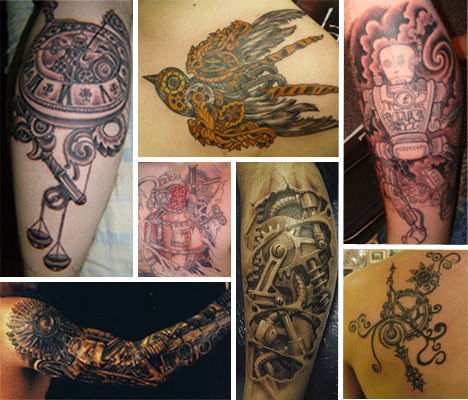
    Steampunk Tattoos

    My sincerest apologies for not keeping up with my scheduled posts this week. So far it's been a darn sight busier with my various other projects than I thought it would be.

    In lieu of the two posts I've missed so far this week, I bring you this picture of Steampunk tattoos courtesy of Mr. Rick Daley:

    Rick found them here: http://weburbanist.com/2010/03/16/cogs-and-ink-steampunk-tattoo-designs-that-wow/

    Monday, June 7, 2010

    Steampunk Mass Communications

    A lot of Steampunk takes place in the latter half of the 19th Century, or possibly the very early days of the 20th. As such, one of the things that takes prominent position -- especially for those stories in the 1890s/1900s -- is the concept of improved mass communication. In The Difference Engine by William Gibson and Bruce Sterling, which takes place in the 1850s, mass communication innovation takes the form of a machine that can slap handbills up on walls while the worker rides in comfort inside the body of the machine.

    In terms of historical innovations, there are several inventions that improved mass communications far beyond what it was for hundreds of years. These include the telegraph, the radio, and improved printing presses as some of the primary changes happening in the 1800s. In the early portion of the 1800s, we also see the invention of the postal system in Britain and the first stamps issued in 1840 -- invented by a schoolmaster named Rowland Hill. Hill was also the first one to design a system where the price of post was determined by weight instead of size.

    Samuel Morse invented the electrical telegraph in 1837 while working at New York University as an artist. Yes, Samuel Morse was an accomplished portrait painter, and worked at NYU teaching students how to paint while he also perfected his design for the telegraph. He would eventually receive patents from both the United States government and European nations, and permission to build telegraph lines linking major cities around the world.

    In 1843, after receiving permission to connect Washington, D.C., and Baltimore, Maryland, Morse first attempted to lay telegraph wires underground using a machine designed by Ezra Cornell (the founder of Cornell University). However, experiment soon showed that the underground method was unacceptable. Thus, we see Morse deciding to string the wires along poles. Eventually, telegraph wires would become such an integral part of communications in the United States that the Native Americans cut the lines in order to effectively disrupt any and all communication between outposts.

    Newspapers also took a quantum leap forward during the mid- to late 1800s. The New York papers realized that the telegraph would change the way people communicated, and were thus early adopters of the technology. Also at this time, we see Robert Hoe's invention of a double-cylinder, steam-powered printing press that exponentially increased the number of broadsheets a newspaper could print. Then, in 1845, his son Richard developed the rotary press. This steam-driven rotary press could produce 100,000 newspapers per hour, a 250 times improvement over traditional hand-cranked presses.

    A second, but no less important, innovation that affected newspapers and communication in general was the typewriter. For the first time, people didn't have to rely on hand-written documentation (which as we all know can be nigh unreadable depending on penmanship). In 1868, Christopher Latham Sholes, in collaboration with Samuel Soule and Carlos Glidden, invented the first usable typewriter.

    However, the initial machine was prone to mistakes and could break easily. Eventually James Densmore, an investor, bought Soule and Glidden out, and he and Sholes built several machines in succession to perfect the device. Densmore and Sholes offered the machine to Remington in 1873, who would eventually purchase the patents after the machine was perfected.

    By the 1880s then, we have the telegraph, the improved printing press, and an actual postal system that are connecting the world. Move into the 1890s and the early 1900s, and we see Guglielmo Marconi and the invention of wireless telegraphy, which would change the communications landscape yet again. (But that's an entirely different post).

    Anyway, what does all this mean for Steampunk? Well, it means several things. First off, you've got a vast array of communications technologies to play with. No television yet, but motion pictures arose in the late 19th Century, and Gibson and Sterling had a kinotrope that was used as a rudimentary projector for presentations.

    As with most Steampunk then, you can take these inventions -- printing presses, radio, telegraphs, etc -- and turn them into some sort of entertaining blend of mechanics to craft an innovation that makes sense for your world. Case in point: in CALLARION AT NIGHT, there's a device called a Wireless Aetheric Communicator. Could I have called it a radio? Probably, but that wouldn't have been nearly as entertaining.

    Thursday, May 20, 2010

    Boneshaker by Cherie Priest

    With the amount of times I've referenced Boneshaker (2009) by Cherie Priest on here you'd have thought I'd do a post devoted to the novel by now. Yeah, been meaning to save it for Gear Bits and Clockwork, but that was also because I'd intended to finish it a month ago. Other work got in the way, though. You all know how it goes. Anyway, enough of my rambling* and on to the book itself.

    Boneshaker is Priest's seventh novel, but her first offering in the Steampunk category. Her previous novels are the Southern Gothic stories of Eden Moore (first novel is Four and Twenty Blackbirds), the rural fantasy Fathom, and the post-Civil War Gothic tale Dreadful Skin. Boneshaker was described by Scott Westerfield as "A steampunk zombie-airship adventure of rollicking pace and sweeping proportions," and I'm inclined to agree.

    Some background on the world of Boneshaker. It's 1880, and the Civil War has lagged on for 18 years. Thirty years prior, gold was discovered in the Klondike (something Priest admits she advanced by a few decades -- historically the Klondike Gold Rush didn't occur until 1896), and the Russians who owned the area at that time wanted to figure out a way to drill through the ice quickly and easily.

    In 1860, the Russians announced a contest -- 100,000 rubles to whoever could come up with a machine that could mine through ice in search of gold. Enter Leviticus Blue, a Seattle inventor, and his Incredible Bone-Shaking Drill Engine (the Boneshaker of the title). Blue convinced the Russians to advance him a huge sum of money to craft the machine, and on January 2, 1863 the engine burst from the basement of the Blue home on Denny Hill and tore through the earth beneath downtown Seattle. The end results of this carnage was the destruction of several banks, and the release of a Blight gas that turned most people unlucky enough to breath it into rotters (Priest's version of zombies).

    The action of the novel picks up seventeen years later, well after the wall went up that closed off the Blighted blocks from the rest of Seattle. We meet three characters to start -- Briar Wilkes, widow of Leviticus Blue; Zeke Wilkes, their son; and Hale Quarter, a historian who's writing about Briar's father Maynard and the history of the Boneshaker and Seattle's destruction.

    Zeke enters the Blighted blocks under the false (according to Briar) impression that he can redeem the memories of both his father and grandfather. What he doesn't know is that the city inside the wall is chock-full of thieves, criminal overlords, scoundrels, undead, and a whole host of others who are only looking out for themselves. Briar discovers his design and is forced to enter the Blighted area herself to bring him out.

    Suffice to say, Boneshaker includes pretty much every element I talked about through the entire Roots of Steampunk series. We've got the Gothic/Urban Gothic story involved through an unclear delineation between good and evil (Zeke is the only truly innocent one in the story; at least from Briar's perspective), the Detective story via Zeke trying to uncover history, the Wellsian Scientific Romance from the high steam technology, the Blighted blocks are a clear Dystopia, and the entire novel is an Alternate History.

    This is classic Steampunk style done very, very well, folks. I've yet to finish reading the book, honestly, but I'm completely engrossed in wrapping it up. I mean come on: zombies, a mad scientist (Dr. Minnericht), criminals as heroes, and an entire city with dangers hidden by the Blight gas fog? How can I not love every second of it?

    Suffice to say, you need to go read Boneshaker. And also pick up Clementine, which is going to be released on May 31. You know you won't regret it.

    *Oh wait, that's what this entire blog is, isn't it?

    Monday, May 17, 2010

    The Pneumatic Post of Paris

    During the latter half of the 1800s, the electric telegraph revolutionized communication across Europe and the United States. The telegraph held particular importance in the financial world, where communications from the stock exchange sent across the wires could make or break an investor. However, there was still a delay for the information to get from the telegraph office to the stock exchange itself.

    This potential money-losing delay prompted J. Latimer Clark's 1853 installation of a 220-yard pneumatic tube between the London Stock Exchange in Threadneedle Street and the Electric Telegraph Company's Central Station in Lothbury. By 1866, there were similar installations in Berlin and Paris. Numerous other major cities followed in their footsteps, and soon the pneumatic tubes carried individual letters and letters in bulk in addition to telegrams.

    Carrying letters in bulk required larger tubes than single letters or telegrams did, and sometimes you'd see pneumatic tubes at a width of 3 inches in order to carry bulk letters. The tubes themselves worked via a pressure differential -- pressure dropped in front of the pneumatic canister, which propelled it along the tube at speeds approaching 25 miles per hour. The letters and telegrams were (and still are) always creased when they arrive, as they have to be rolled to fit in a tube.

    The Parisian network, which is the subject of this post, had its first tube line put into place in 1866, between the telegraph offices at the Grand Hotel and the place de la Bourse. In 1867, this was extended into a one-way hexagon between the telegraph offices of place de la Bourse, rue Jean-Jacques Rousseau, rue de Rivoli, rue des Saints-Peres, the Central Telegraph Office (rue de Grenelle), rue Boissy d'Anglas, and back to Grand Hotel.

    A map of the Parisian network of pneumatic tubes from 1971..

    During the decade between 1867 and 1877, a two-day tube was laid between Central and Bourse and several additional polygonal systems were hooked into the system. The system was opened to the public in 1879, and by 1881 it was decided to connect the whole of Paris to the network. The tubes that ran through the Paris sewers mainly consisted of 65-mm diameter tubing, but from 1888 on, there were more 80-mm tubes put in. The one-way tubes within the system were also swiftly replaced with two-way tubes. As of 1974, about one-third of the pneumatic post system used the larger-diameter tubes.

    Sadly, the Parisian network of pneumatic tubes -- the Poste Pneumatique -- was only in operation until 1984. At its height in 1953, the network spanned 450 kilometers underground and carried 11 million pieces of mail per year. 

    Imagine seeing this system at its height. This huge system of pneumatic tubes zipping mail to and fro around a massive metropolis while the telegraph clicks away in the next office over. The frenetic activity as your Steampunk hero goes into the pneumatic post office to send a telegram zooming to the halls of power. Kind of cool isn't it? 

    Thursday, May 13, 2010

    The Affinity Bridge by George Mann

    The Affinity Bridge by George Mann can easily be called a blend of Urban Gothic, Detective Fiction, and Scientific Romance into the milieu that becomes Steampunk. Mann, who is the head of a major British SF/Fantasy publishing imprint, takes tropes from each of the three aforementioned genres, and has a grand old time twisting them into one mystery after another.

    Sir Maurice Newbury and Miss Veronica Hobbes, his brilliant assistant, are charged with the tracking down of an escaped automaton, the investigation of a series of strangulations attributed to a glowing policeman, and oh yes, the plague of revenants ravaging London's slums.

    Newbury himself is a detective in the vein of Sherlock Holmes -- brilliant, logical, fascinated by the new steam technology spreading around England, and slightly addicted to drugs. Of course, the Holmes enthusiasts among us will correct me that Holmes wasn't actually addicted. He merely experimented.

    The story itself is in 1901 London, with airships and other steam-powered and mechanical innovations spreading quickly around the nation. Queen Victoria is kept alive by a rudimentary life support device of bellows and mechanical workings, and is still very much in the thick of the action. Newbury acts on her orders and hers alone -- as an agent of the Crown he goes where the Empire wills him to go. And Hobbes follows behind him, partially to help, but also to make sure Newbury remains a loyal servant.

    The "affinity bridge" of the title is a link that allows for transference of a human consciousness from a living person into one of the story's ubiquitous automatons. Newbury and Hobbes uncover the secret behind this act in a factory belonging to some automaton makers, who are also connected to the plague revenants (zombies). We have Urban Gothic from the fog of the slums and the "hidden city" therein, the Detective Fiction piece from Newbury and Hobbes' investigations, and the Scientific Romance from the dark use of technology in the form of the affinity bridge.

    Perhaps the most interesting thing about this novel is that it ends up being very Victorian in language and grammar. It's a fascinating choice for Mann to make, and one that actually ends up working quite well when you get into the swing of the novel. Mystery, action, science, and a breakneck pace ... what more could you want?

    Monday, May 10, 2010

    Steampunk Optics

    This morning, upon skimming back on my previous posts about Steampunk tech and Steampunk in general, I realized that I hadn't yet touched upon the science of optics. Now, this is a fascinating topic (I say that about everything though, so take it with a grain of salt), because the science of optics itself traces its way 23 centuries ago to the third century B.C. and the ancient Greeks. Our old friend Hero of Alexandria is mentioned in the extant literature on the topic, as is Euclid (who you may remember from geometry class). Both of these men composed major works on the nature of light and reflection, which set the stage for later innovations into lenses for sight correction and telescopes.

    Euclid theorized (wrongly) that sight worked by beams shooting from your eyes to the object itself. He also noted that light travels in straight lines and described the laws of reflection. Hero used a geometric method to prove that the path a ray of light reflected from a plane mirror takes is shorter than any other reflected path that might possibly be drawn between the reflected object and the point of observation. A circa 140 AD text attributed to Cladius Ptolemy also included a study on refraction.

    It wasn't until 965 AD, and the work of Ibn-al-Haitham (sometimes called Alhazen in extant literature) that we see the beginnings of optics as we know it today. Alhazen worked with spherical and parabolic mirrors in his experiments, and was aware of a concept called spherical aberration (a point of light looks different on the outer edge of a spherical lens as opposed to the inner edge).

    The 13th century saw the work of Robert Grossteste (a professor at Oxford) who theorized about the nature of light, his student Roger Bacon who worked with convex lenses to magnify objects, and Witelo's Perspectiva, which was destined to become the premier text on optics until the 17th century. 

    Isaac Newton, Johannes Kepler, and Galileo Galilei -- the giants of optics -- all operated in the 1600s throughout Europe. In 1608, Hans Lippershey -- a Dutchman -- was the first one to build a working telescope. From here optics exploded with developments in knowledge of light and magnification all through the 17th, 18th, and 19th centuries -- Kepler helped refine both the telescope and microscope, and from Newton's work on Optics, later scientists were able to discern a whole host of theories about light and the way it acts.

    Well into the 19th Century, and still today, there are advances in telescopes and microscopes ongoing, which allows us to see farther into the distance of space and deeper into the microscopic realm.

    So what does this mean for Steampunk? Glad you asked that question, dear reader (Yes I know you didn't ask. Work with me here).

    It means that when it comes to magnifying instruments and the like, the sky is pretty much your limit. Gail Carriger has a device called "glassicals" in her Parasol Protectorate series, which amount to a set of glasses with lenses that flip down to allow ever-increasing levels of magnification. Because the science for all types of optical tech dealing with lenses existed (except for the fun electron microscope and varieties of other entertaining toys that allow you to see into people's bedrooms from halfway around the world), you have little to no historical fact stifling your creativity when it comes to magnification tools.

    Case in point, Moriah at several points uses binoculars to spy on people. In a short story I finished writing last night, Dmitry (a side character in CaN) uses special goggles to see from a distance and protect his eyes. The moral of this lengthy post is basically that, when using optics, stay away from anything electric and you are good to go for a Steampunk extravaganza.

    ADDENDUM: Here's a full timeline of developments in Optics.

    Thursday, April 22, 2010

    The Roots of Steampunk -- Detective Fiction and a Devotion to Logic

    Logic has been the guiding star of many a fictional detective: Sherlock Holmes, C. Auguste Dupin, Hercule Poirot. The list goes on and on when you consider the number of detectives who use their minds and not their fists to solve murders, burglaries, and all sorts of conspiracies before they destroy the government.

    In 1841, Edgar Allen Poe wrote "The Murders in the Rue Morgue," in which he introduced Dupin and logical detection to the world. This story is the archetype for innumerable detectives since then -- Holmes, Poirot, and Nero Wolfe among them -- where the narrator of the story is a personal friend of the detective and the solution to the case is presented before the reasoning that lead up to it. Dupin was also the archetype of the brilliant, logical detective.

    Dupin was the founding character of what would eventually become common tropes of detective fiction: the eccentric but brilliant detective, the bumbling constabulary, the first-person narration by a close personal friend. Contrary to some later detectives, Sherlock Holmes included, Poe sets up the Paris police as a foil to the detective -- law enforcement very much does not want Dupin's help in this tale. Poe himself called his Dupin stories "tales of ratiocination" as opposed to detective fiction, a term that would come into being later.

    Across the pond in England, Charles Dickens added a mystery subplot to Bleak House, where a lawyer is murdered in his office and Inspector Bucket of the Metropolitan Police Force has to solve the crime. However, it's Wilkie Collins, a protege of Mr. Dickens, who's The Woman in White is considered the first great mystery novel. T.S. Elliot called Collins's The Moonstone (1868) "the first, the longest, and the best of modern English detective novels ... in a genre invented by Collins and not by Poe."

    Where Poe crafted the brilliant detective that's such a fixture of the genre, Collins added in several other characteristics that mark many twentieth century mystery novels:

    • English country house robbery
    • An "inside job"
    • red herrings
    • A celebrated, skilled, professional investigator
    • Bungling local constabulary
    • Detective enquiries
    • Large number of false suspects
    • The "least likely suspect"
    • A rudimentary "locked room" murder
    • A reconstruction of the crime
    • A final twist in the plot
    You'll notice that Poe and Collins share the bungling constabulary and reconstruction of the crime tropes of detective fiction. I think both of them are equally responsible for birthing the genre, but also agree with the historians who place the genesis with Poe and not Collins. That might also be an American-centric viewpoint (for which I apologize to my international readers).

    And then, in 1887, we come to one Mr. Sherlock Holmes of 221B Baker Street, London. If anyone can be said to rocket detective fiction into the stratosphere, then Holmes is it. The brainchild of Sir Arthur Conan Doyle, Holmes has become a by-word for the part of the brilliant outside detective who assists the police with solving crimes via his brilliant deductive reasoning. Conan Doyle stated that he based Holmes off Dr. Joseph Bell, for whom Conan Doyle worked as a clerk at the Royal Edinburgh Infirmary. Dr. Bell was apparently famous for drawing large conclusions from the smallest of observations.

    What does this all offer to Steampunk? Well it depends on what you're looking for. In the case of George Mann's The Affinity Bridge, Sir Maurice Newbury and Miss Veronica Hobbes use their deductive reasoning skills to discern the whereabouts of a missing automaton, investigate the strangulations attributed to a glowing policeman, and battle a zombie plague in London's slums. The Affinity Bridge is Steampunk wedded to Detective Fiction in the tradition of Holmes and Dupin.

    Much of Steampunk has a devotion to logic inherent in the tale. Victorian sensibilities abound with logical deduction and reasoning, at least in fiction, and stories like The Affinity Bridge carry it forward into Steampunk tales. Alexia Maccon, nee Tarrabotti, the heroine of Gail Carriger's Parasol Protectorate series, is also highly devoted to logical reasoning when it comes to the underpinning conflict of the stories.

    Logic and science fiction go hand-in-hand in other words. Logical underpinnings to the world, mystery subplots, and all sorts of clues and puzzles included in a story are the hallmarks of Detective Fiction and the class of Steampunk that owes its roots to the great detectives of Victorian fiction.

    Tomorrow: A special guest blogger writes on Steampunk Fashion
    Monday: Sir Arthur Conan Doyle's The Hound of the Baskervilles

    Tuesday, April 6, 2010

    The Roots of Steampunk -- Gothic Literature

    One of the major aspects of steampunk comes from its dystopian elements. The Difference Engine by William Gibson and Bruce Sterling weaves in dystopic facets, as does Boneshaker by Cherie Priest. Though the first dystopian story is generally accepted to be After London, or Wild England by Richard Jeffries (1885), the influence of Gothic Literature, and particularly Urban Gothic, cannot be understated.

    Gothic literature can be tied to the Gothic Revival movement in architecture of the same time period. The writers of Gothic literature focused on extremity of emotion and the creation of Atmosphere (yes, the capital A is important), in addition to the general theme that man's works would not last forever. The focus of the Gothic Romances that came about in the late 18th and early 19th centuries was thus the the creation of this dark and terrifying world through psychological and physical terror.

    Prominent stories from this period include Mary Shelley's Frankenstein (1818), The Castle of Otranto by Howard Walpole (1764), and The Old English Baron by Clara Reeve (1778). One of Jane Austen's works, Northanger Abbey, is valuable because it references a series of novels now nicknamed the Northanger Horrid Novels. There was a timeframe where Gothic writers, specifically Ann Radcliffe, were seen as composing sensationalistic women's entertainment (sounds like the bad rap romance novels get today, huh?).

    This is the genre that birthed the Byronic hero, a man who is "mad, bad, and dangerous to know," and yet is seen as a heroic figure in spite of that. This strikes me as a forerunner of the Anti-Hero trope that is so common in modern fiction.

    Tales like Frankenstein, and the Victorian Gothic stories of Edgar Allen Poe and others gifted us with the dark, brooding aesthetic of later horror novels and the extremity of emotion needed in the darker steampunk works. Oscar Wilde's The Picture of Dorian Grey offers fodder for dark discussion about beauty and Faustian deals with the best of them. The story is chilling in one of the best sorts of ways, and forces you to think about how far you're willing to go to protect the things that matter to you.

    Darkness and terror characterize the great Gothic stories of the Victorian period, something any author interested in the darkness of humanity can learn a lot from.

    Thursday: Mary Shelley's Frankenstein; or, The Modern Prometheus*

    * Tomorrow is Secret Archives day.

    Monday, April 5, 2010

    The Roots of Steampunk -- Introduction

    The word "Steampunk" has been on a lot of writer's lips since the genre began spilling over recently. Leviathan by Scott Westerfeld, Boneshaker by Cherie Priest, Soulless and Changeless by Gail Carriger -- these are just a few of the steampunk novels that have risen to attention among the wider community of readers.

    With those works in the public eye, and numerous pubbed and unpubbed writers (yours truly included), discussing what the genre is, I thought it might be a good idea to go over the works and authors that have influenced what we now call Steampunk.

    Over the course of the next two weeks, I'll go through the styles, authors, and stories whose aesthetic, themes, and settings all blended together into what we now call Steampunk. Follow me on the journey if you care to, and I promise I'll try to make it interesting.

    Monday, March 29, 2010

    Genetics, Steampunk, and Fantasy

    Donna Hole on Friday brought up a good point in the comments (I'll restate here so you don't have to click through):
    "While reading this, I was wondering if you couldn't equate Sauron with a mad scientist with all the gene splicing to create his orks and Brukhi (I know, I spelled it wrong, but I didn't want to get up to get the book). There have been other fantasy novels also that the evil wizard practiced a form of organic or genetic fusing to create the creatures that did their nefarious bidding. Cave weights, Kabold, Dark Elves, gnomes."
    Genetics, if anyone remembers science class, was first codified by the monk Gregor Mendel in the mid-19th Century while experimenting on inherited traits in pea plants. However, people have been cross-breeding plants and pets (dog breeds are an example) since ancient times. Classical Sparta practiced selective breeding in its citizens -- look at the movie 300 for an object example. In the opening scenes, we see an elder of Sparta investigating a baby to see if he passes muster for inclusion into Spartan society. If he did not, then the child could've expected instant death.

    Simple genetics thus deals with traits inherited from two "parents," whether human, animal, or plant. In this manner, wizards like Sauron and Saruman in the Lord of the Rings trilogy can be considered mad scientists because they blend Orcs and Goblins into the new Uruk-hai, a race of creatures that can move in the sun like Orcs but have the strength of Goblins. This simple usage of inherited traits falls under the general umbrella of genetics.

    With steampunk, genetic manipulation takes on a more contemporary feel. In Scott Westerfeld's Leviathan, for example, we see the British Army using fabricated animals crafted after Charles Darwin's discovery of DNA and genetics. Truth be told this is actually an expansion on what we know about DNA manipulation -- modern science only allows for very simple organisms to be built, not anywhere near on the scale of the whale airships in that novel.

    A simple search of "genetics in fiction" brings up a list of books both at Barnes&Noble and Amazon, but much more in the future/near-future science fiction realm than in steampunk or in standard fantasy. Of course, this could also be tied to people not always considering certain things as genetic science rather than "magic" as in fantasy.

    Genetics offers such opportunity for authorial hand-waving or even honest-to-goodness fictional science, that I'm slightly surprised it hasn't quite been done to death in modern fiction. Then again, it might have been without me noticing (which is entirely possible).

    But I'm curious: what other novels, films, or video games can you think of that deal in genetics as a plot point? And do you think genetic manipulation and its consequences has been overdone in storytelling?

    Friday, March 26, 2010

    Mad Scientists

    One of the hallmarks of the steampunk aesthetic is the Mad Scientist. There are two kinds of folks who fall into this category -- engineers who build fantastic machinery and physical scientists who work with the organic side of things. Examples of both are Doctor Loveless from Wild Wild West and Doctor Victor Frankstein from the eponymous novel.

    Doctor Frankenstein works in what's called "natural philosophy" (another term for the blend of chemistry, biology, and medicine that existed before science became compartmentalized). His story focuses the proto-steampunk aesthetic of Frankenstein on the science behind reanimating dead flesh. More often than not, we see something like this in horror movies rather than in science fiction. However, and this is a fairly big "however," the biological sciences lend themselves very easily to steampunk when set in the right time frame.

    Gail Carriger's Soulless, which I've blogged on before, includes a cabal (I love that word) of mad scientists who are trying to craft supernatural creatures by using blood transference. They expect that doing so will allow them to understand the supernatural enough to destroy it. This story's timeframe is the 1850s, a fact Carriger is well aware of, and thus she gives the scientists just enough knowledge to sound like academics of the period.

    Scott Westerfield, on the other hand, admits that Leviathan assumes that genetics and DNA were discovered decades before their actual point in scientific history. That's the only way certain bits of his technology can work. If, however, you accept this, then the scientists still need to not have the same benefits that an early 21st Century geneticist would. It's hard to manage, but worthwhile in order to craft an effective view of the world.

    The engineer-type mad scientist is exampled by Doctor Loveless of Wild Wild West. This is the Will Smith/Kenneth Branagh* version I'm talking about, by the way. In that movie, Doctor Loveless creates a steam-powered mechanical spider that evokes images of Godzilla and the great (bad) monster movies of decades before. He also has a mechanical wheelchair of his own devising, and augmented his soldiers with mechanical accouterments. His mad science exampled itself by the mechanical devices that he used in his villainy rather than any sort of fiddling with genetics.

    The webcomic Girl Genius by Phil and Kaja Foglio deals with both kinds of Mad Science. When a character in their version of Europe (Europa) has the skill to craft fantastic machines or play Devil Went Down to Georgia on the fiddle of someone's genetic code, they're called Sparks. These "Sparks" have the possibility of flipping into Mad Scientist mode at any time. Sometimes this happens with hilarious results.

    Anyway, my point is thus: Mad Science is a tried and true application of the steampunk worldview. In fact, one of the things you see a lot in the works that birthed the genre and the proto-steampunk novels is a sort of nod to the way technology can both go right and go horribly wrong. In this, steampunk shares its themes with general science fiction. But, if you add the science of the Victorians with the technology they had at their fingertips, well then you get a chance to play with some very entertaining insane people who happen to be really, really smart.

    * I'll watch any Kenneth Branagh movie at least once. Say what you want about his commercial films -- very few actors can rock Shakespeare like he can.

    Tuesday, February 16, 2010

    Coming Up With Ideas -- Answers Day One

    Seeing as Donna, Adam, and Stephanie were kind enough to ask questions on yesterday's post, I figured I'd devote an entire post to each of their questions. Because I'm nice like that. Yeah, that's the reason.

    Anyway, I'll go in the order of being asked, since that seems to be the fairest way to go about this whole process. That means Donna's inquiry is up first ... since she was, you know, first.

    Coming Up With an Idea


    The beginnings of what would eventually become CALLARION AT NIGHT can be traced to the fall semester of 2005. I was driving to college one morning -- 45 minutes one way from my parents' apartment to campus -- when the phrase "God, satyrs are annoying" popped into my head at random. I spent the next several weeks coming up with why the speaker thought satyrs were annoying, and eventually wrote the short story "Moriah, Child of the Rowan."

    Moriah didn't have a last name in that story, but she was already a tracker and a half-nymph at that point. The character of Cynthia Bluecallow was originally a human blacksmith named Alice, and Nicolai's original name was Jacob (he was really, really smarmy in that incarnation). The hatred of half-nymphs and half-satyrs was well in place in that story, though the society wasn't nearly as closed as the current version.

    Another major difference between that story and the current one is that Dahliah (Moriah's mom) had left the city to become Chief Archon of the Woodland, instead of the reason she gives in the current novel. Her name also wasn't Dahliah in that version. The original name escapes me though.

    After I finished the umpteenth rewrite of SON OF MAGIC in April 2009, I decided I wanted to leap right back into another story to give myself time to decompress from writing that one. Thus, CALLARION AT NIGHT was born. I started writing it as a traditional fantasy, but quickly decided to make it a steampunk instead. And thus I found the perfect science fiction/fantasy subgenre for me to write in.

    The rest, as people are wont to say, is history.