Showing posts with label Repost. Show all posts

Tuesday, November 16, 2010

REPOST: Steampunk Technology and Culture: Why the Railways Developed

In the midst of working hard on my Roots of Steampunk paper for presenting this weekend, I realized that I haven't put anything up here in a over a week. However, since my brain is mush, all I can do is offer up this post that originally appeared on July 27, 2010.

One of the things we forget, looking back at the proverbial march of history, is that many of the innovations we take for granted today were new and frightening at one time. The locomotive, the telegraph, the radio, electricity; the list goes on and on. And while I've spoken about two towering figures in the development of the railways in Britain (and by extension the rest of the world), it struck me recently that I didn't yet talk about the cultural impact of those very same railways.

"Hindsight is 20/20," as the old saying goes. Looking back at the early 1800s, when the first moves were being made toward steam locomotives and iron railways crisscrossing the countryside, we now can clearly see the economic and social benefit that steam locomotives provided. However, the people living in that time didn't have the benefit of knowing how much cheaper the locomotive would turn out to be, and how much of an improvement over canals and horse-drawn coaches this new technology actually was.

Consider how long the British people lived with the horse and the ship as the main modes of transportation. Horses had been used by the inhabitants of Britain since at least 1,000 BCE, and seaborne transit was almost a no-brained, given the nature of the landmass as an island. Most people knew horses and boats; they knew how to operate them and they knew what to expect from them. By the same token, very few people knew what to expect out of a steam locomotive. You'll recall the image I posted of Richard Trevithick's "puffer" that went along the railway at Penydarren -- no one had ever seen anything like it before that day in 1804.

People weren't certain that mobile steam engines were any better than horses right up until George Stephenson proved the point at Rainhill in 1829. Until that time, most of the railways in Britain were oak logs with a replaceable strip of beachwood nailed on top, set on iron sleepers. The horses walked on tracks of cinders in between the rails of the tramway. And this method worked for quite a few decades before the locomotives came around.

So what changed to make the railways suddenly a more viable option than horses pulling carts to a landing point at a canal, where the barges would float your goods down to market? Well, for starters, the Napoleonic Wars had something to do with it.

The Napoleonic Wars drove the price of horse feed through the proverbial roof. Gavin Weightman makes a stellar point in The Industrial Revolutionaries:

"It is a modern prejudice, it has been said, to imagine horses are a cheap form of power: in reality, the cost of 'running' them could rise of fall alarmingly with the price of hay and oats and the military demand for mounts. (119)"
Horses were expensive, and so too were the canals that crisscrossed the English countryside and carried goods to market. The canal companies were businesses as well, and had to charge exorbitant fees if they wanted to offer any dividends at all to their shareholders. Thus mine owners started to consider how they could transport their goods to market at the same or better speed than the canals, with a pricepoint much lower than the one they currently paid.

Even after Trevithick's success at Penydarren, and the dozen or so other collieries that slowly gained steam locomotives, most mine owners still weren't convinced that the machines were better that horses. Oh they accepted that there should be a cheaper way to transport their goods to market than using the canals, but it took George Stephenson's Rocket and his victory at Rainhill to truly prove that locomotives were better.

In 1831, the Liverpool-Manchester line that the Rocket was designed for carried, according to Weightman, "445,047 passengers, 43,070 tons of cotton and other merchandise and 11,285 tons of coal. (134)" Though the passenger total ended swinging back and forth like on a pendulum, the tonnage of merchandise carried by the Liverpool-Manchester line only increased.

By Queen Victoria's coronation in 1837, there were roughly 80 railway companies intent on adding track to the ever-growing rail network across Britain. In a single year, more than 1,000 miles of track were laid down across the English countryside. If any single innovation could be said to drive the Industrial Revolution, these dozens of miles of railway track laid down across England (and soon elsewhere in the world) could be pointed to fairly simply.

So why did the railways develop when they did, at the very base of it? Because of a combination of money, technical know-now, and the ability of financiers to see that this invention could make moving their product very, very easy indeed.

Steampunk Relevance

Much of early Steampunk deals with the culture effects of technology as well as the main story the author or authors wish to tell. Case in point is The Difference Engine by William Gibson and Bruce Sterling. The three interwoven stories in that narrative prove themselves as concerned with the effect technology has on the people of Britain as on the main story of discovering what the heck is going on with Ada Lovelace and the cards from the French computer. Michael Moorcock's Warlord of the Air does something similar, as he imagines differences between our world and that of the one Oswald Bastable falls into.

Technology and culture are inextricably tied together, as certain technologies only arise when the surrounding culture is ready for them and not before. A good example is this knowledge: the Romans knew how steam power worked. They had the technology to build a proper engine and set it crisscrossing the Imperial landscape. Why, you may ask, would they not do so and begin an Industrial Revolution in 102 A.D.?

The answer's simple: the technology didn't develop because the culture didn't need it to. Britain in the 19th Century needed the locomotive to develop. This is why that's where it came into being. The end result of all this is a simple question you need to ask yourself when developing a Steampunk world:

Would this technology happen in the culture I've created?

NOTE: An awesome book to read on the topic of why some countries became industrialized and others didn't is Guns, Germs, and Steel by Jared Diamond.

Tuesday, August 24, 2010

REPOST: The Perils of Alternate History

I'm still technically on a blog-break from giving you new material. No worries though, I've got most of September's posts already kicking around in my head. Anyway, without further ado I give you this re-run from November 23, 2009.

One of the hallmarks of traditional steampunk is that it's a re-imagining of the mid to late 1800s or early 1900s, when steam power was the dominant technology. Tied in with this alteration in technology is changes to the historical record. The Difference Engine, for example, has Lord George Gordon Byron (who didn't die in the Greek War of Independence in that world) as prime minister in the 1850s, and a United States of America that's fragmented into several constituent parts -- the Republic of Texas, the Republic of California, the United States of America, and the Confederate States of America are the largest.

Whenever you alter history, you run into the problem of making historical characters act the way they would normally act. Harry Turtledove, one of the alternate history masters, has several series where he adds "watershed" events that alter the course of history. In the Worldwar and Colonization novels, he posits what would happen if aliens invaded Earth in the middle of World War II. In what's called the Southern Victory or Timeline-191 series (not officially, mind you), he considers what would happen if the Confederacy was victorious in the American Civil War.

In How Few Remain, Turtledove includes Samuel Clemens as a sharp-witted newspaper editor in San Francisco of the 1880s. Clemens, best known as Mark Twain, did in fact work in San Francisco in the 1800s -- except he was there in 1864, and was living in Hartford, Conn., during the time frame Turtledove's story occurred. The problem with doing this, of course, is that Turtledove has to have his fictional Clemens react to events in the same, or similar way, the real Clemens would have.

The above is why I've tended to shy away from historical fiction/alternate history, besides my previously stated fear that I'd get drawn too far into research. The possibility that someone would read my story and say "so and so would never do that" for a historical character has previously been too great for my liking. Of course, that also changes as the documentation on a particular person increases. For the major figures of history -- Abraham Lincoln, Charlemagne, Napoleon Bonaparte, etc. -- you can find enough extant scholarship that getting them right is only a matter of reading enough.

I have tremendous respect for the folks who build careers from alternate histories or straight historicals. My hat's off to their research prowess, which far outstrips my own. Those people are the real research gurus. 

Tuesday, June 22, 2010

REPOST: The Crafting of a City Map

This post originally appeared on March 23, 2010. 

My propensity for doing a lot of research is well-known across various people's blogs (and now on Twitter), but perhaps less well-known is my need to do a lot of background figuring because of this.

One of the criticisms I got from my fantabulous betas (you know who you are) was the lack of a sense of place/time differential when Moriah travels through the city of Callarion. The easiest way to fix this is to design a map of the city. However, one of the problems with doing such a thing is my lack of any drawing ability whatsoever. Instead of drawing that map then, I've decided to craft some background information on architecture and distances in various parts of the city.

This amounts to yet more research (and some unrepentant cribbing of real places) to craft the exact city map that I need in order to give the city its verisimilitude. So far, today, I've written capsules on Marketplace, Quayside, and Woodsedge (three districts of the city) and will at some point finish the ones on Lowtown, Academe, and Gardens Hill as well.

The map and geography that I'm using for Callarion borrows from three places -- Rome, San Francisco, and San Diego. San Fran and San Diego provided the proper winding coastline that I imagined, and Rome's Seven Hills provided the basis for what I kind of wanted to do terrain-wise (turns out Callarion's looking more and more like San Francisco by the minute, but that's beside the point).

What purpose does all this serve? Perhaps the biggest benefit to doing this is having a map means I don't accidentally place Thomas's shop in two different sections of Marketplace. It also means Gardens Hill consistently stays in the center of the city, and other landmarks start to gain more and more importance because they're located in a concrete place in the fictional city. Correction: the biggest benefit is that my distances stay the same. That's important, because I can't have Moriah cross Marketplace on foot at two different speeds. There lies inconsistencies my friend.

And I very much dislike being inconsistent (which is why I always like people to point out when I am). What about you, loyal blog readers? Do you craft maps of your settings? Or do you let it fly like Terry Pratchett, who's of the opinion that "You can't map a sense of humor"?

Monday, June 21, 2010

REPOST: Steampunk and Automatons

This post originally appeared on February 12, 2010.

Back in my post about cyborgs in steampunk, I mentioned that the Ancient Greeks had automatons. This is borne out by the historical record: Philo of Byzantium (3rd Century BCE) crafted an automaton maid that would pour water or wine when a cup was placed in its left hand.

The very word, automaton, is derived from the Greek word automatos -- "acting of one's own will." And, as so many cool advances that occurred in Greece during the time of the great inventors, the automatons were considered toys, religious tools to impress worshipers, or even as ways to demonstrate general scientific principles. Hero of Alexandria (who gets more press on this blog than any other inventor besides da Vinci) created siphons, a fire engine, and a programmable cart among other things as examples of his automaton skills.

There's a stanza from Pindar's Seventh Olympic Ode that refers to the island of Rhodes, well known for its proliferation of automatons:


The animated figures stand
Adorning every public street
And seem to breathe in stone, or
move their marble feet.

The Ancient Chinese also had automatons, as evidenced by this excerpt from Lie Ze:

"The king stared at the figure in astonishment. It walked with rapid strides, moving its head up and down, so that anyone would have taken it for a live human being. The artificer touched its chin, and it began singing, perfectly in tune. He touched its hand, and it began posturing, keeping perfect time...As the performance was drawing to an end, the robot winked its eye and made advances to the ladies in attendance, whereupon the king became incensed and would have had Yen Shih [Yan Shi] executed on the spot had not the latter, in mortal fear, instantly taken the robot to pieces to let him see what it really was. And, indeed, it turned out to be only a construction of leather, wood, glue and lacquer, variously coloured white, black, red and blue. Examining it closely, the king found all the internal organs complete—liver, gall, heart, lungs, spleen, kidneys, stomach and intestines; and over these again, muscles, bones and limbs with their joints, skin, teeth and hair, all of them artificial...The king tried the effect of taking away the heart, and found that the mouth could no longer speak; he took away the liver and the eyes could no longer see; he took away the kidneys and the legs lost their power of locomotion. The king was delighted."

Automatons have existed in the Middle East since the 9th Century CE, and are described in numerous texts from the time of Islamic scholarship. Al-Jazari, the famous Muslim inventor of the 13th Century, described a boat with four automatic musicians that he used to entertain partygoers. There was even an automaton duck in the 18th Century that mimicked digestion.

Suffice to say, automatons have existed for a really, really long time. What's this mean for the writer of steampunkery?

Playtime! Because the science of how to craft automatons has existed for so long, it's a well-documented method of adding robotics to your steampunk tale without applying too much modern science. Studying the texts of Signore da Vinci and those of Jacques de Vaucanson, the French inventor who crafted the aforementioned Digesting Duck, is a good start for more contemporary designs. Philo's automatic maid is well-documented via translations of his works, if you want to go more ancient.

George Mann's automatons in The Affinity Bridge are controlled via punch cards, if you want a literary example of how to do it. And The Difference Engine has an example of the Japanese Karakuri ningyō, which were designed in the 19th Century.

 A tea-serving Karakuri, designed in 19th Century Japan, with the mechanism at right. 
It functioned exactly as Philo's automatic maid did.

All you have to do, of course, is to make sure your automaton design makes sense. There's little worse than crafting some awesome technological advance and having it fall flat because the design isn't logical. 

Thursday, June 17, 2010

REPOST: The Affinity Bridge by George Mann

This post originally appeared on May 13, 2010.

The Affinity Bridge by George Mann can easily be called a blend of Urban Gothic, Detective Fiction, and Scientific Romance into the milieu that becomes Steampunk. Mann, who is the head of a major British SF/Fantasy publishing imprint, takes tropes from each of the three aforementioned genres, and has a grand old time twisting them into one mystery after another.

Sir Maurice Newbury and Miss Veronica Hobbes, his brilliant assistant, are charged with the tracking down of an escaped automaton, the investigation of a series of strangulations attributed to a glowing policeman, and oh yes, the plague of revenants ravaging London's slums.

Newbury himself is a detective in the vein of Sherlock Holmes -- brilliant, logical, fascinated by the new steam technology spreading around England, and slightly addicted to drugs. Of course, the Holmes enthusiasts among us will correct me that Holmes wasn't actually addicted. He merely experimented.

The story itself is in 1901 London, with airships and other steam-powered and mechanical innovations spreading quickly around the nation. Queen Victoria is kept alive by a rudimentary life support device of bellows and mechanical workings, and is still very much in the thick of the action. Newbury acts on her orders and hers alone -- as an agent of the Crown he goes where the Empire wills him to go. And Hobbes follows behind him, partially to help, but also to make sure Newbury remains a loyal servant.

The "affinity bridge" of the title is a link that allows for transference of a human consciousness from a living person into one of the story's ubiquitous automatons. Newbury and Hobbes uncover the secret behind this act in a factory belonging to some automaton makers, who are also connected to the plague revenants (zombies). We have Urban Gothic from the fog of the slums and the "hidden city" therein, the Detective Fiction piece from Newbury and Hobbes' investigations, and the Scientific Romance from the dark use of technology in the form of the affinity bridge.

Perhaps the most interesting thing about this novel is that it ends up being very Victorian in language and grammar. It's a fascinating choice for Mann to make, and one that actually ends up working quite well when you get into the swing of the novel. Mystery, action, science, and a breakneck pace ... what more could you want?

Tuesday, June 15, 2010

REPOST: Originality

This post originally appeared on November 25, 2009. Is it still plagiarism if I copy myself?

"Good writers borrow from other writers. Great writers steal from them outright." -- Sam Seaborn, The West Wing Season 4, Episode 2 "20 Hours in America."

One of the banes of the writer's existence is the push to produce something that is fresh, new, and original. Some people actively try to write something truly original, and in fact purposely avoid anything even close to what they're attempting to compose.

I can't think of any artist (of any stripe) working in a vacuum that can produce something accessible to the general populace. Even the great epics of ancient history -- Gilgamesh, The Iliad, the creation of myths of Scandinavia and other nations to name a few -- came from rich oral traditions of these same stories. The Iliad and the Odyssey were even spoken for decades before someone wrote them down.

No worthwhile art, I feel, is "original" in the purest sense of the word, i.e. that nothing like it ever came before. Mozart, Stephen King, Archimedes of Syracuse, Leonardo da Vinci, and other artistic and scientific luminaries of the past how-ever-many thousand years of human history all had influences from somewhere. And yet we call the greatest among us "original thinkers."

Why is that?

Because they had the ability to synthesize what was available into something new. Leonardo da Vinci took concepts that already existed in the Renaissance and used them to design his inventions. Archimedes developed weapons of war that held back the Romans through experimentation and study. Stephen King's Dark Tower series was, by his own admission, based off a viewing of Sergio Leone's The Good, The Bad, and the Ugly. And Mozart composed some of his most famous music -- The Marriage of Figaro among that -- while at court in Vienna, where he was exposed to other composers.

This process, synthesizing our influences, is how we create original works. Everything we write is influenced by something else. Accept that, and you'll be better equipped to make a story that shines with the one original element you possess.

You.

Monday, June 14, 2010

REPOST: Steampunk Aeronautics

I'm taking a two-week break from the blog. My official vacation starts Thursday, but I want to spend what free time I have this week working heavily on my various writing projects. Hence, you get a look back, on schedule, of my various posts on Steampunk, Writing, and etc. This post originally appeared on November 2, 2009.

Airships such as zeppelins, hot-air balloons, dirigibles, and blimps, which are collectively known as lighter-than-air aircraft, operate based on the principle of buoyancy. The principles of buoyancy were first described by Archimedes (the genius Greek as I call him), and are also the reason why ships float and submersibles sink.

Now, the three above types of airships are also called rigid (zeppelin), semi-rigid, and nonrigid (blimp). The first manned flight of any airship, though the buoyancy concept is several thousand years old, came about in 1783 when the Montgolfier brothers (Joseph and Etienne) flew their hot-air balloon over their hometown of Annonay, France.

The Montgolfiere balloon, 1783.

According to About.com, the first passengers were a sheep, a goat, and a duck. The history of using animals as test pilots goes back quite a bit, apparently. In October 1783, Pilatre de Rozier and Marquis d'Arlandes became the first human passengers in the Montgolfiere balloon; the balloon was in free flight during that October journey, meaning that it wasn't tethered to the ground.

Subsequent advances added flaps to control the balloon's flight (Jean Blanchard, 1785), and crafted a silk balloon that was filled with hydrogen gas (Jacques Charles, 1783) instead of the superheated air that filled the Montgolfiere balloon.

Blanchard's hydrogen balloon with flaps, 1785


These early balloons couldn't be navigated very well (at all really), and several advances were made to improve that aspect of their design. One of the first was adding an air screw that operated similar to a rudder on a ship; the balloon's shape was also elongated into the cigar that we know today.

Steam power as a method of propulsion and navigation came into play in 1852, when Henri Giffard's dirigible was the first to add the system onto an airship. Giffard's invention flew from Paris to Trappes, a distance of 17 miles, but didn't have enough power to fly against the wind in order to make the return journey.

Giffard's airship, 1852


The top speed of Giffard's airship was 5 miles an hour, which was the top speed until Brazilian Albert Santos Dumont crafted his gasoline-powered airships in the late 1890s. Airships, for lack of a better phrase, really took off after Dumont's innovations.

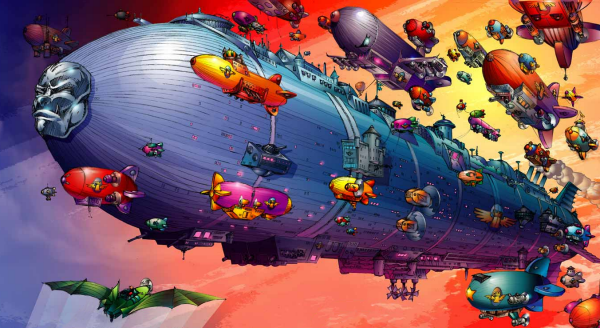
In 1900, Ferdinand von Zeppelin, a German count, designed and flew the first successful rigid airships. His designs were so successful that rigid airships are commonly called Zeppelins in his honor. It's these rigid airships that figure strongly into steampunk, sometimes with elaborate designs as seen in the Girl Genius online comic (Castle Wulfenbach) and in other literature in the same genre (Keith Thompson's War Zeppelin).

The LZ-126, USS Los Angeles, 1924

The above photo is of one of the Zeppelins that were ubiquitous before the 1937 Hindenburg disaster that pretty much ended the commercial use of lighter-than-air aircraft.

Because of this, in fact, one of the easiest ways to show that you're writing steampunk is to include zeppelins zipping across the skylanes or other aerial vessels that aren't airplanes, helicopters, or gliders.

For design considerations, take a look back at the Steam's Limitations Series.