Thursday, September 30, 2010

Steampunk Character Type: The Suffragette


Both women and men can fulfill the Mad Scientist/Quirky Inventor or Adventurer character types in Steampunk, but there is one particular character type unique to women that took on particular importance during the late 1800s. The Suffragette arose with the drive for women's rights that took place throughout much of the Western Republics during the late 19th/early 20th centuries. We have women like Susan B. Anthony, Elizabeth Cady Stanton, Muriel Matters, Louisa Lawson, Viscountess Nancy Witcher Astor, Emmeline Pankhurst, and the list goes on and on.
Susan B. Anthony

Though the historical Suffragettes crusaded for women's rights, there isn't a need to do the same in order to fall under the Suffragette character type. A fine example of this character type, in fact, is Alexia Tarabotti from Gail Carriger's Parasol Protectorate series. Alexia is intelligent, independent, and though she's aware of her place within society she isn't hidebound by the societal mores she doesn't agree with.

The proper Suffragette character type is that type of woman -- intelligent, independent, and capable of ignoring established laws when they stand in her way. The Suffragette's of history were almost all very, very smart women who were focused on altering the established rules of society to give women all sorts of rights under the law that they didn't have before in the Western Republics.

Not every independent female character is a Suffragette-type, but many of them are. The character archetype of the Warrior Woman from fantasy novels is subsumed under the Suffragette umbrella within Steampunk, primarily because the drive for Women's Suffrage took place smack in the middle of the time period where much of Steampunk is set. Both character types can still exist in a Steampunk world, but the Suffragette is almost more natural because she understands the nature of the society she lives in and seeks to change it for the better.

In terms of real-life Steampunks, I can think of few better examples for the attitudes of the "punk" suffix of the word than the Suffragette. She quests for change in the world around her, to give a voice in government to groups that don't yet have one or to help change an attitude that has sent her nation spiraling down the proverbial tubes. She also might be a wife and mother, sometimes to a husband that shares her goals and sometimes to one that tells her she should give up and accept the world for what it is. However, the fictional Suffragette can't do that because she sees an injustice and something in her character forces her to right it.

I realize, as I write this, that I've created Moriah Rowani (heroine of CALLARION AT NIGHT) as a Suffragette character. She doesn't really start off this way, but eventually becomes a leader when she realizes the true depth of the wrongs going on in the city.

An alternate side is the Suffragette-as-villain; this might be someone who's had a psychotic break and is convinced that something's wrong with the world when it's really not, or someone who's taken their quest to the extremes of using fear tactics and hatred to change things. Granted, this is my personal opinion (and one you're welcome to disagree with).

Can you think of any other Suffragette characters in fiction?

Tuesday, September 28, 2010

Winners of The Dark Deeps Contest

All right, Princess Freers, here's the promised official announcement of the winners of an ARC for Arthur Slade's The Dark Deeps, The Hunchback Assignments Book 2:

Winner number one is ....

Nemone7
"After an evening of pipe-smoking and clever deductions peppered by witty remarks, nothing delighted Dr Watson more than sitting at his desk to record Holmes’ effortless fits of brain power for posterity. Or so dear gyroscopic Sherlock believed.

The truth was quite other, hidden in the basement of a little-known Gentlemen’s club ,The Smoke. Here, after limping down treacherous damp stairs, the good doctor smiled at the innumerable little eyes and hands and hearts(yes, hearts) awaiting his ministrations .Here ,in his cozy workshop by the rumbling steam engine that powered other gentlemen’s unavowable endeavours, De Watson’s delicate surgeon fingers fit together cogs and wheels, wound with copper wire, tensed with springs. Here, Sherlock Holmes’ gentle shadow built his army of clockwork toys, and gave them life. Every tiny copper heart beat for him."
 And, by popular Twitter vote, the winner of the second ARC is ...

K. Marie Criddle
"Black Beauty is a roguely, darish animal that won't sit kindly by and be traded around like a common gooseberry, if one catches one's drift. He wears a saddle of fine oiled leather and brass buckles from the finest of purveyors that purvey that type of stuff. His hooves have been modified with clanking, steam powered pistons that build and store energy for those much needed dashes through the bustling streets of London. Step gingerly, or your legs might not be too merry, Brass Beauty! The end. I'm too tired to think of more."
Thank you to Mia Hayson and Paul Singleton for rounding out the entrants, and forcing me to turn to Twitter for the final winner of the second ARC, seeing as your entries were simply too awesome for me to choose.

I'll have another contest here in October, so anyone who didn't win here is more than welcome to come back along for that one as well.

Nemone7 and Marie, please email me your mailing addresses so I can ship your books out to you.

The Fur Trade as Steampunk?


The fur trade played a major role in the North American economy for more than 300 years, beginning in the 1500s when the first European explorers traded with the Native American/First Nations tribes at seacoast trading areas and all the way up to about 1850. Up until the first planned move into the interior of North America in 1608, the Europeans were content to trade guns, cloth, and manufactured goods for beaver pelts and the furs of the fox, mink, otter, and marten.
Image taken from the Canpages blog

The fur trade in North America is divided into three periods -- the French Era, the British Era, and the American Era -- which are roughly bookended by three major conflicts in North America over the course of 250-year official history of the trade. The French Era ran from 1608, when Samuel Champlain ordered Etiene Brule to go live with the Huron tribe in order to learn their ways, up to the conclusion of the French and Indian War in 1760 when New France was taken over by Britain.

The British Era of dominance in the fur trade ran then from 1760 to 1816, with only slight interruption by the American Revolution. I say slight interruption only because the battles of the American Revolution centered on the eastern coastline of the continent, whereas the fur trade was focused around Grand Portage and the Great Lakes out around Minnesota, Michigan, and Wisconsin. Some traders avoided areas south and east of the Great Lakes as a result of the Revolution, but business did not slow by any stretch of the imagination.

In 1815, the United States government forbade any foreign traders from operating inside the country. This expelled the British fur traders, and forced the North West Company (an organization focused on the fur trade) to depart from the areas now controlled by the United States. Thus began the American Era of fur trading in the U.S., which lasted until 1850 when silk hats and not the felt ones made of beaver pelts became fashionable.

Fort Chipewyan was founded in 1788 on
the shores of Lake Athabasca
in the Canadian North.

(Canada's First Peoples website)

The White Oak Society, Inc of Deer River, Minnesota has a complete timeline of major events in the North American fur trade on their website. That particular organization is also fascinating because they're a living history group that focuses on re-creating what the fur trade would've been like in 1798 -- right at the height of the industry, when the Hudson Bay and North West companies duked it out for dominance over the fur trade of North America.

The fur trade had far-reaching effects on North American society. Many of the French Canadians now living in the United States, for example, might be able to trace their family tree to a fur trader or trapper that lived around the Great Lakes in the 17th, 18th, or 19th centuries. The Metis people would not have existed without the French fur traders in Canada, as the Metis are the children of the French trappers and their First People wives.

We might have the stories of Davy Crockett and Daniel Boone without the fur trade, but Crockett wouldn't have his famous coonskin cap if not for the popularity of furs when he was alive.

And lastly, the border between the United States and Canada might be different if the fur trade hadn't existed. A lot of the boundary line in the Great Lakes area was determined by which trading posts controlled which territory. The demarcation that separated U.S. territory from Canadian territory was drawn where it is today because of the fur traders on both sides of the line.

The fur trade is tied closely into the North American experience, and as result it can tie well into Steampunk stories set throughout the northwest United States and the majority of Canada. I can already imagine a group of itinerant fur traders driving their steam-powered wagon through the Saskatchewan (wow I'm kind of surprised I spelled that word right first try) wilderness toward the North West Company's trading post at Fort Chipewyan, where the mechanical weigher and counter will determine how much they get paid for their load of beaver pelts. It's definitely a story that could be distinctly North American, especially if you mix in a few words of French, Metis, and English into the various conversations.

You could even use the Steampunked fur traders as a microcosm to show how the advanced technology of Britain has changed their world, or give France the higher technology and see the French and Indian War go a different direction, with Britain losing her colonies in the Americas.

Things to think about, most definitely.

CONTEST ANNOUNCEMENT: There will be a separate post later today detailing the winners of the ARCs for The Dark Deeps.

Monday, September 27, 2010

Elisha Collier's Flintlock Revolver


The revolver concept is often attributed to Samuel Colt, whose famous revolvers were the ones that the U.S. Army used during the Indian Wars of the post-Civil War period. According to an apocryphal story about the invention of the Colt Paterson, Samuel Colt's first revolver, the invention was inspired by viewing the rotation of a ship's steering wheel on a voyage from the United States to England. Colt made a wooden model of the revolver based upon his observations, and would eventually produce the Patterson pistol upon his arrival home.

Elisha Haydon Collier's flintlock revolver,
patented in 1818 in Great Britain
(Quazen.com
Although Samuel Colt's revolvers took the world by storm, it was actually another American inventor by the name of Elisha Haydon Collier who invented an early form of the revolver. Elisha Collier's revolver differed from Colt's in several key respects, but the primary one was that Collier's revolver was a flintlock and Colt's used percussion caps.

Prior to Collier's 1818 patent in England, the only multi-shot pistols were the pepperbox guns, which were distinct in that each bullet had its own barrel. Collier's flintlock revolver was one of the earliest weapons that used a single barrel through which all the bullets would successively fire. The flintlock revolver also lightened the weapon and made it easier to load; not having to place one bullet per barrel cut down on the time to load the weapon significantly.

Though Collier's flintlock revolver was an improvement over the earlier pepperboxes, the design of the gun still presented several problems. As in the pepperbox guns, there was a possibility for a multiple spark from the flint to cause all the bullets in the chamber to ignite. With the pepperbox this wasn't so much of an issue -- each bullet had its own barrel and thus all could exit the gun at the same time -- but Collier's flintlock revolver didn't have that benefit, and thus explosions could still happen.

The other primary issue with Collier's flintlock revolver is the issue that all flintlock weapons had. The flint itself would wear down quickly, and thus needed to be replaced quite often. Also, the flintlock revolver could misfire if inferior gunpowder was used in its operation. The standard operation of the flintlock revolver wasn't much different from the flintlock muskets of an earlier time, except for the multiple bullets and the revolving barrel.

Collier's flintlock revolver fell out of favor by the 1840s and '50s, when Samuel Colt and Smith & Wesson developed their pure revolver concepts that used percussion caps instead of flintlocks as an ignition source. When Elisha Collier returned to his native Boston in 1850, Samuel Colt had taken an additional step of difference by mass-producing the Colt Paterson and other hand guns in factories rather than hand-making the weapons as Collier had done with his flintlock revolver.

The Victoria & Albert Museum in London has one of Collier's flintlock revolvers in its collection, as a bequest of Major Victor Alexander Farquharson, and their page devoted to the gun has a detailed description of its materials and dimensions. Perhaps the most interesting thing for the Steampunk writer is that the weapon is made of forged steel, brass, and wood. These materials are as standard to Steampunk as the day is long.

One can almost imagine an underdeveloped nation armed with flintlock revolvers and muskets against an invading force using steam-powered automatic weapons and pure revolvers. It kind of sounds like the way much of Eastern Europe fell to the Germans during the run-up to World War II.

Any ideas for how a flintlock revolver could fit into Steampunk? I'd love to hear them!

Friday, September 24, 2010

A Possible Basis for Miss Havisham

Today's random historical nonsense bit comes from The History Place, which I discovered on doing random Google searches. The story's very, very sad, but is a potential basis for the character of Miss Havisham in Charles Dickens's Great Expectations. The full text is taken from The History Place's Strange but True! page:
Jilted in 1846 by shipping clerk George Cuthbertson, 21 year old Eliza Emily Donnithorne was condemned to a life more suiting a bat than a pretty heiress of aristocratic birth.

Probably driven away by her overbearing father, Cuthbertson would die in India during the Sepoy rebellion in 1858, while his fiancée in Sydney waited anxiously for his return.

Suffering a nervous breakdown due to her abandonment, Eliza insisted the wedding feast be left untouched on the long dining room table in the grand mansion, Camperdown Lodge, ready for festivities and ceremonies to commence once the absent groom arrived.

Her orders were complied with by her father, retired Judge James Donnithorne, over concern for her state of mind. Those concerns were amplified by Eliza's refusal to wear anything except her wedding dress as she whiled away the days waiting for her groom. Unknown to all, Eliza was in the early stages of pregnancy.

To avoid further scandal, her newborn baby was spirited away by the Judge who arranged for its adoption while falsely telling his daughter of its death. This blow, coupled with the subsequent death of her father, sent the pretty young woman over the edge.

After her father's funeral, all but two servants were dismissed. The imposing estate would be sealed off from the world for the next 40 years. Windows and shutters were permanently closed, drapes drawn, and the house was blanketed in total darkness. Expensive European paintings and furnishings were gradually blanketed in the dust of decades, falling to ruin anonymously while weeds and overgrowth consumed the outside of the once stately house.

A generation of neighbors were born, lived and died, believing the house to be abandoned. Oblivious to the passage of time, Eliza grew old. Her wedding dress decayed and hung off her withering body as she drifted like a ghost through the dusty ruins of her world.

She refused to leave the grounds or see anyone except her lawyer and minister, who described rotting chairs collapsing under them as the mistress of the house held court, sitting solemnly in her discolored wedding dress while candles cast eerie shadows on the walls. Merciful death finally arrived in 1886 when Eliza died of heart disease, a fitting end for a woman who suffered so long from a broken heart.

A generous woman, her donations helped build the local church where she was buried, while the bulk of her considerable estate was left to charities and her trusty servants.

It is believed novelist Charles Dickens heard of her abandonment and subsequent reclusion through one of his sons and based the character Miss Havisham in his novel Great Expectations on her.
Like I said, it's a sad story and yet one that is fascinating all the same. Reminds me of the sailor's widows in New England who had the widow's walk around the top of their ocean-side homes. I seem to recall more than a few widows who would go up to the roof of their home to watch for the husband that never came home.

Thursday, September 23, 2010

Steampunk Character Type: The Adventurer

We've all seen them in fiction -- the Adventurer-Hero strikes a victorious pose with his fists on his hips and chest puffed out while the villain scrabbles away, defeated. But while this evokes images of the superheroes extant during the comic book Golden Age, and is the one that many of us can conjure up, I'm talking about Adventurers that occur in fiction significantly earlier.

Allan Quartermain. Tom Sawyer. Phileas Fogg. The Time Traveller. These are just a few of the Adventurer characters from classic fiction. As to the names from Steampunk novels? Well that's easy too -- Modo and Octavia (The Hunchback Assignments), Croggon Hainey (The Clockwork Century), Bergen (Whitechapel Gods) ... you get the picture.

We see the Adventurer a lot in Steampunk fiction, but what really typifies the character? How do we know when we've seen an Adventurer and not a regular person thrust into the story's primary plot line against their will?

The Adventurer is comfortable in dire situations. In fact, he almost prefers them to the the quiet supposedly idyllic life he once came from. The classic Adventurer were men (and the occasional woman) who went off into the world in search of far-off lands and peoples, sometimes with the intent to study them but more often to see the sights and see what would happen to them there. A sub-character type is the Adventurer Archaeologist (Indiana Jones), which is actually nothing like archaeology actually is anymore (but once was in the 19th Century).

The Voyages Extraordinaire of Jules Verne are rife with Adventurer characters which, seeing as those are Adventure stories, isn't really that big of a surprise. Phileas Fogg, Captain Nemo, Professor Arronax, etc and so on -- the characters that exist in Verne's stories are men of Action and Adventure. That's the kind of Adventurer-Hero many people have come to expect. He's the man of Action who acts without thinking, and yet somehow always manages to win the girl at the end of the story.

The spirit of Adventure that runs through the root works of Steampunk, and the genre's other basis in the pulp adventure novels of the late 1800s, make it clear that the Adventurer character type is here to stay.

What other traits can you think of that describe an Adventurer character?

Wednesday, September 22, 2010

The Gatling Gun -- Steampunk Weaponry for Real


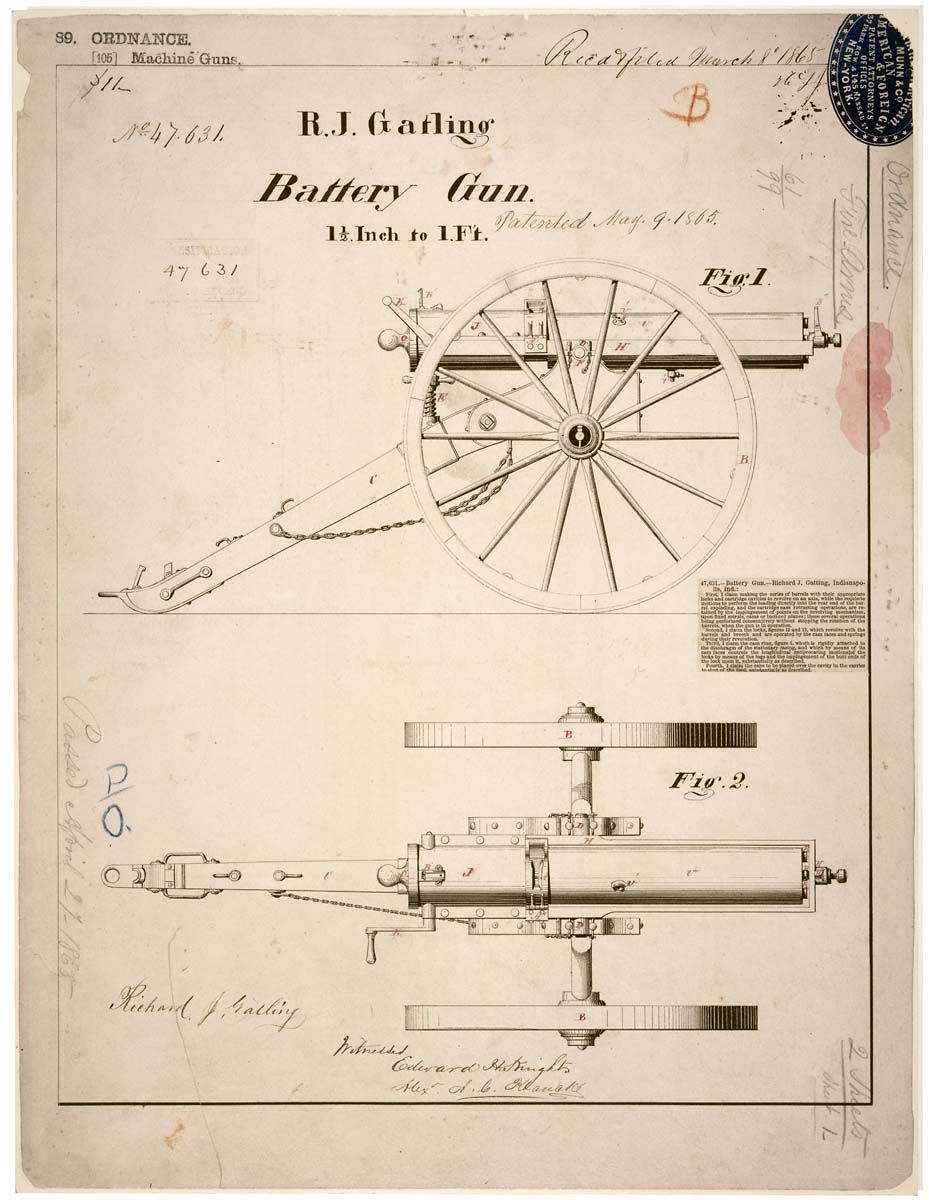
Doctor Richard Gatling's patent drawing
In 1861, Doctor Richard Gatling invented a six-barreled machine gun capable of firing 200 rounds per minute. This "Gatling gun," as it would be known, was designed with the express purpose of decreasing the number of men on the battlefield. In creating it, Dr. Gatling hoped that it would reduce the amount of bloodshed in war and eventually even end war all together. His thought was that the carnage his weapons wreaked would make armies reconsider before they marched to war. Gatling's own words written nearly two decades after the invention of the weapon bear this out.
Hartford, June 15th, 1877
My Dear Friend.
        It may be interesting to you to know how I came to invent the gun which bears my name; I will tell you: In 1861, during the opening events of the war, (residing at that time in Indianapolis, md.,) I witnessed almost daily the departure of troops to the front and the return of the wounded, sick, and dead. The most of the latter lost their lives, not in battle, but by sickness and exposure incident to the service. It occurred to me if I could invent a machine--a gun-- which could by its rapidity of fire, enable one man to do as much battle duty as a hundred, that it would, to a great extent, supersede the necessity of large armies, and consequently, exposure to battle and disease be greatly diminished. I thought over the subject and finally this idea took practical form in the invention of the Gatling Gun.
Yours truly,
R.J. Gatling
As history has proven, however, Dr. Gatling was way off the mark.

The original Gatling gun models saw use in dozens of wars around the world, from the Spanish-American War of 1898 to the colonial conflicts in Africa and other undeveloped nations. The colonial European powers made particular use of Gatling's weapon to bolster their fortifications against hordes of warriors. Once the destructive power of the Gatling gun was realized, the technology spread around the world like wildfire.


The Gatling gun was operated by a hand-crank, which meant that it wasn't the first truly automatic weapon (that title goes to the Maxim gun invented in 1884). Regardless of this lack of automation, the Gatling gun still holds the title of first machine-fed gun useful on the field of battle.

Prior to Gatling's invention, the most common multi-shot weapons were the French mitrailleuse and grapeshot fired from cannons. The problem with both of those weapons was that they had to be reloaded after every shot, so the high mass rate of fire was counteracted by the slow manual loading process.

The operation of the Gatling gun was different. From The American Civil War Home Page:
"The Gatling gun was a hand-crank-operated weapon with 6 barrels revolving around a central shaft. The cartridges were fed to the gun by gravity through a hopper mounted on the top of the gun. 6 cam-operated bolts alternately wedged, fired, and dropped the bullets, which were contained in steel chambers. Gatling used the 6 barrels to partially cool the gun during firing."
Mitrailleuse Gatling model APX1895
(Musée de l'armée, Paris, France)
That same site places the Gatling gun's rate of fire at 600 rounds per minute (100 rounds per barrel), but other resources have a stated rate of fire of 200 rounds for an unskilled operator. Though the weapon was used in the American Civil War, it was still new and the "unskilled" operator was probably the most common one to find at least in the early years. Besides that, the 600 rounds per minute rate of fire seems more a theoretical rate rather than a practical one.

It's worth noting that the Gatling gun wasn't really adopted by the United States Army until 1866, after the war ended. This can be tied to the many problems that the original 1862-patented design had. Among these was the jamming potential of the original design, which was prodigious because of the tapered barrels that ran the risk of not always aligning properly with the chambers. The bullet design that the first Gatling gun used -- a steel chamber full of black powder and primed with a paper percussion cap -- was both fragile and expensive, as self-contained brass bullets had not yet become available.

The 1866 redesign of the Gatling gun included those aforementioned brass cartridges among other improvements, which finally resulted in the gun being picked up by the U.S Army. The Gatling gun was used extensively in the conflicts of the latter part of the 19th Century, going so far as to make the journey to Puerto Rico during the Spanish-American War in 1898. Gatling's weapon made its appearance at San Juan Hill among other battles.

In 1876, the weapon had reached theoretical rate of fire of 1,200 rounds per minute. It's important to note that this is a purely theoretical rate, as in practice it was more likely to achieve 400 rounds per minute. This is still an impressive rate of fire for a weapon that required a four-man team to operate. Its "Bruce"-style feed system, where one row of bullets could be loaded while the other was being fired, allowed for the greater increase in rate of fire.

The U.S. Army decommissioned all its Gatling guns in 1911, declaring them obsolete and dropping the rotating barrel technology for several decades. Then the 1940s rolled around, and new designs based on the Gatling model were developed for use on fighter planes -- thus the Vulcan Gatling gun was born, and eventually a lighter three-barrel version was even developed to use on helicopters. The design is still used on fighter jets today.
Inspection of the gatling gun of an A-10 Thunderbolt II, at Osan Air Base, Korea. (from Wikipedia, Photo by USAF Staff Sgt. Bradley C. Church)
As it relates to Steampunk, the Gatling design is the consummate multi-shot heavy weapon to use against massive numbers of infantry. Many of the "gun arms" of fantasy steampunk worlds such as the Wild Arms game are Gatling-style weapons; so much so when you use the phrase "gun arm," one almost immediately thinks of a set of rotating barrels.

Hook the crank to a steam engine that runs on high-pressure steam, and you have a purely automatic weapon that can potentially be fired by a man sitting in a giant robot. The best part about the Gatling gun is that Dr. Gatling was a consummate mechanical engineer, which makes his simple and effective design perfect for use in a Steampunk society where gearwork and steam power dominates.

How would you design a Steampunk Gatling-style weapon? What materials would you use?