Showing posts with label Steampunk Books. Show all posts

Wednesday, October 27, 2010

GUEST BLOG: What If?

Jon S. Lewis is the co-creator of the world of The Grey Griffins in The Revenge of the Shadow King (2006), which has been optioned for a movie by Deathly Pale Productions. A new Grey Griffins trilogy begins with The Brimstone Key, Book I of The Clockwork Chronicles. The book is the first foray into Steampunk that Jon and co-author Derek Benz have taken with the series.

I spent quite a few Saturdays in my local comic book shop growing up, and I was always intrigued by Marvel’s What If titles. Each issue asked a deep philosophical question like “What if the X-Men died on their first mission?” or “What if Spider-man had six arms?”

Okay, so maybe the questions weren’t very deep, but we’ve all played the “what if” game, right? “What if I would have married the first person I kissed?” or “What if I would have gone to medical school like my brother who drives the BMW?”

“What if?” became an important question for the Grey Griffins . . .

Derek and I decided early in our writing careers that we weren’t going to name modern technology in our books. That meant words like “cell phone,” “laptop,” “SUV,” and “iPod” were banned. Why? Technology is moving so rapidly that we didn’t want to date the stories. I mean, when we were writing our first book (The Revenge of the Shadow King), the term “smart phone” wasn’t even coined yet, Napster had stronger brand recognition than iTunes, and eReaders were little more than a dream.

There was a problem, though. Tweens and teens are hardwired into digital communication and even though the hardware is bound to change, their passion for digital media won’t. So introducing technology into the series was critical, but how could we do that without making our stories stand out like butterfly collars, bellbottom jeans or parachute pants?

At about that same time, Derek picked up a copy of Alan Moore’s The League of Extraordinary Gentlemen. We were already fans of the Steampunk aesthetic, but for some reason the idea of introducing Steampunk into our stories hadn’t crossed our minds. Alan Moore helped us see the light, and we asked ourselves the following question: “What if our world was invaded by Steampunk culture?”

It was the perfect solution! We could introduce futuristic technology wrapped in a timeless package, like laptops in leather cases with brass corners where the keypad looked like it was taken from an early model Remington typewriter. And instead of walking around in wizards robes, the students at Iron Bridge Academy could wear things like classic safari gear, petticoats, knickers with argyle socks, driving caps and goggles.

Then, instead of fighting trolls, dragons and faeries, we could set our heroes against fresh villains like clockwork soldiers and steam-powered war machines. It was too delicious to pass up.

We hope the end result is an action-packed adventure that fans of our original trilogy will enjoy. At the same time, we’re excited about introducing a new crop of readers to Steampunk in much the same way that J.K. Rowling introduced an entire generation to fantasy books through Harry Potter. Okay, so maybe we won’t have quite that impact, but you never know.


EDITOR'S NOTE: The contest to win a Grey Griffins prize pack is open until November 5; put your entry in the comments thread of the announcement post to be entered for a chance to win.

Monday, October 25, 2010

The Brimstone Key, Book I of The Clockwork Chronicles by Derek Benz and J.S. Lewis


The Brimstone Key (Little, Brown, June 2010, $15.99 in Hardcover, 369 pages) is the first installment in a new trilogy featuring the Grey Griffins -- Max Sumner, Harley Eisenstein, Ernie Tweeny, and Natalia Romanov -- regular kids from Avalon, Minnesota who became monster hunters under the tutelage of the Knights Templar in the first trilogy authors Derek Benz and J.S. Lewis conceived of.

I never read the original Grey Griffins trilogy, so to come at The Brimstone Key from the perspective of a neophyte to the characters was an interesting one. There's an entire swath of character development and history that I missed out on by not reading the first three books, but Benz and Lewis write so skillfully that I didn't feel lost for a second. The narration gives background without pulling the reader from the story, and switching between the perspectives of Max, Natalia, Harley, and Ernie helped keep the reader abreast of everything that's going on while making certain the reader's not lost.

This new story opens with the Griffins on the eve of transferring into Iron Bridge Academy, a Templar training school for young people who are being trained in the hunting of monsters. But all's not well at Iron Bridge. Soon after the school year starts, changelings (children with fairy blood) begin disappearing -- taken in the dead of night via magical portal. The Griffins realize that the strange hiding place they discovered over the summer, filled with mechanisms and blueprints of clockwork devices, holds more importance than they realized. Especially as one name comes up again and again: Otto Von Strife, the Clockwork King.


Von Strife spent a century locked up in one of the Round Table cards so central to the Grey Griffins series, and when he gets out and starts wreaking havoc, it falls to the Griffins and their Templar allies to move against him. After the climax of the story, I'm certain the rest of the books in the trilogy will keep the adventure moving.

As to the Steampunk elements, Benz and Lewis chose to create Iron Bridge in a city called New Victoria, that retained its Victorian sensibilities, which is on the other side of the veil from Avalon, Minnesota. The children of Iron Bridge dress in Steampunk garb complete with goggles and brass fittings on their outfits -- the goggles are explained because they allow games of Round Table to be played in 3D -- and of course since the Griffins are completely lost in the realm of fashion the authors are allowed the freedom to explain the style of the clothing.

Clockwork robots, Steampunk clothing, and a city that never moved past the Victorian Age are just a few of the fun Steampunk elements within a very, very fun opening to a new trilogy of stories. There's some good tearjerker moments as well, particularly if you've read the original stories that featured the Griffins. That's not to say a reader can't pick up this novel without having read the other ones. I did, and certainly found the story to be engaging, engrossing, and entertaining without feeling lost in the slightest.

I'm definitely looking forward to the second book -- The Relic Hunters, due out in Spring 2011.

And now we move onto a CONTEST!!

There are several prizes available for this fun little contest:

FIRST PRIZE: A copy of THE BRIMSTONE KEY with signed bookmarks, and your choice of one of the following posters:

* SIM Chamber (like the X-Men Danger Room): http://www.jonslewis.com/images/432_ggSIMsketch.jpg
Second, Third, Fourth, and Fifth place winners will each get their choice of poster. 
Now for The Rules:

In the comments of this post, tell me your wackiest idea for a Steampunk invention that could exist today. Portable mechanical kinotrope? Steam-powered automobile with the ability to brew tea while driving? Artificial limb that runs on mechanics? 

The crazier the invention, the more fun it is. Your inventions will be scored based on plausibility, purpose, and inventiveness, and the contest will end on Friday, November 5.

Oh, and I'm running the same contest at Gear Bits and Clockwork and Doctor Fantastique's Show of Wonders, so remember to head over there to posit your inventions as well. That gives everyone 15 chances to win something! You read that right: 15 chances to win.

All entries must be received by 12 am on Friday, November 5 to be considered.

SPECIAL NOTE: There will be a guest post from J.S. Lewis, co-author of The Brimstone Key, later this week; Mr. Lewis will be talking about the challenges of integrating Steampunk tech into contemporary times.

Thursday, September 9, 2010

Steampunk Character Type: The Mad Scientist/Quirky Inventor

Among my fascinations is the study of archetypes and stereotypes in fiction and life. Steampunk, for all the possibilities it provides, isn't immune to the creation of such character standards. In fact, one of the most prevalent Steampunk character types is the Mad Scientist or, if the scientist is a good character, what I've termed the "Quirky Inventor."

The distinction is important for several reasons: A Mad Scientist and a Quirky Inventor both create outlandish inventions that defy the laws of science, but the differences lay in how the invention is used. Where the Mad Scientist uses his inventions to gain power for himself or to prove someone wrong, the Quirky Inventor is more apt to use his science to help people or, in the more naive examples, believe that he's helping people.

A good example of a Quirky Inventor is Doctor Emmet Brown from the Back to the Future movies. His time machine was invented because he came up with the idea and wanted to see if he could make it work. The intentions behind the Delorian time machine were innocent -- building the device only -- but the end result of how it was used became the central conflict of the movies. Even at the end of Back to the Future, Part III, the steam-powered time train was created so Marty wouldn't worry about Doc and Clara.

By contrast, a standard Mad Scientist is someone like Doctor Moreau from H.G. Wells's The Island of Doctor Moreau. According to TVTropes.org, one of my all-time favorite websites:
"The titular vivisectionist isn't as early as Frankenstein, but he played a major role in shaping the trope. He had Einstein Hair - decades before Einstein. He had the Mad Scientist Laboratory - his island (and he likely brought tropical island laboratories into vogue). Cast out from society, with only one assistant? Oh, yes. He did it all For Science but used extremely painful methods that would give any PETA representative nightmares. Turned on by his own creations? Of course. Several films adaptations even give him a beautiful daughter of his own creation. He also provided the beginnings of the Reluctant Mad Scientist - he never intended to get revenge on the other scientists who cast him out, and in his own mind he had noble purposes for his work; it's only his (possibly willful) ignorance of how torturous his methods are that makes him less than a sympathetic character."
For non-literary examples of the proper Mad Scientist, who is completely unrepentant and uncaring about who his science hurts, you don't have to look much farther than the Doctor Who series. Davros, who created the evil race of Daleks, is the prime example of the maniacally evil Mad Scientist who uses his brain power to further his own twisted goals.

Steampunk is rife with Mad Scientists. There's Doctor Cornelius Hyde in Arthur Slade's The Hunchback Assignments, Professor Minnericht in Cherie Priest's Boneshaker, the Hypocras Club/Order of the Brass Octopus* from Gail Carriger's Parasol Protectorate series, and John Scared in S.M. Peters's Whitechapel Gods to name a few. Wacked-out inventions that run on steam power or clockwork mechanics, strange uses of biology to develop new creatures, genetic anomalies made even weirder in the gaslight. Steampunk is very much the playplace of the mad scientist.

Take these madmen of science though, and give them a heart. Give them remorse and an aim to better the situation of their fellow man. Then you have a Quirky Inventor. He may have the same insane devotion to SCIENCE that the Mad Scientist does, but the difference is that the Quirky Inventor has a morality that essentially forces him to follow some variation on the Hippocratic Oath. Distilled down to its essence, the Quirky Inventor is a Mad Scientist who uses his brilliance for good and not for evil.

What other examples of Quirky Inventors or Mad Scientists do you know of in fiction or in real life?

NOTE: I avoided talking about Victor Frankenstein, the eponymous doctor of Mary Shelley's seminal novel, because he's an unique case in fiction -- many Mad Scientists don't reject their original aims like he did, which is the point of that story.

* Gail Carriger gave me the correct name of her Mad Scientist group on Twitter earlier this evening. Hence you see the correction.

Thursday, July 1, 2010

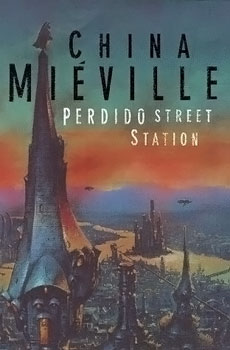
Perdido Street Station by China Mieville (2000)

China Mieville's Perdido Street Station (2000) is the first novel set on the fictional world of Bas-Lag, in the city-state of New Crobuzon. It's Steampunk, but of a fantasy bent rather than purely scientific as in alternate history Steampunk stories.

In an interview with 3am Magazine, Mieville himself summed up the novel like so: "It's basically a secondary world fantasy with Victorian era technology. So rather than being a feudal world, it's an early industrial capitalist world of a fairly grubby, police statey kind!"

This is a prime example of effective Second-World Steampunk; upon reading the story, you get a sense of the dystopic vision that is New Crobuzon -- from the hideous Remade, to the buglike Khepri and even more distinct arcane races that live alongside humanity. And of course there's the ruthless Parliament and their militia. After all, what dystopian society would be complete without a corrupt government?

The story of Perdido Street Station follows Isaac, a scientist, and Linn, his Khepri girlfriend. A Garuda, a creature from the deserts far away, comes to Isaac with a request to reattach the Garuda's wings. Apparently the wings were ripped off for a crime so terrible that the Garuda, Yagharek, claims it has no human equivalent.

Isaac of course accepts the challenge, and meanwhile Linn is running afoul of the vast crime syndicate operating in the city. The plotlines converge after Isaac begins study of a multicolored, unidentified larva that he gains though illegal channels. This caterpillar eats only a hallucinogenic drug called "dreamshit." Isaac of courses feeds the caterpillar copious amounts, and eventually births a slake-moth -- a creature that feeds off the dreams of sentient beings and leaves them in a catatonic state.

Perdido Street Station won a whole mess of awards: It won the British Fantasy Society's August Derleth Award in 2000, the Arthur C. Clarke Award in 2001,the Premio Ignotus Award in 2002, and the Kurd Laßwitz Award in 2003. It also won the Amazon.com Editors' Choice Award in Fantasy in 2001.

Suffice to say -- China Mieville can weave a darn good yarn. This is a prototype for Second-World Steampunk stories, and its dark fantasy tones have served me well in my own writing.

NOTE: The cover is from the original UK printing of the novel.

Thursday, June 17, 2010

REPOST: The Affinity Bridge by George Mann

This post originally appeared on May 13, 2010.

The Affinity Bridge by George Mann can easily be called a blend of Urban Gothic, Detective Fiction, and Scientific Romance into the milieu that becomes Steampunk. Mann, who is the head of a major British SF/Fantasy publishing imprint, takes tropes from each of the three aforementioned genres, and has a grand old time twisting them into one mystery after another.

Sir Maurice Newbury and Miss Veronica Hobbes, his brilliant assistant, are charged with the tracking down of an escaped automaton, the investigation of a series of strangulations attributed to a glowing policeman, and oh yes, the plague of revenants ravaging London's slums.

Newbury himself is a detective in the vein of Sherlock Holmes -- brilliant, logical, fascinated by the new steam technology spreading around England, and slightly addicted to drugs. Of course, the Holmes enthusiasts among us will correct me that Holmes wasn't actually addicted. He merely experimented.

The story itself is in 1901 London, with airships and other steam-powered and mechanical innovations spreading quickly around the nation. Queen Victoria is kept alive by a rudimentary life support device of bellows and mechanical workings, and is still very much in the thick of the action. Newbury acts on her orders and hers alone -- as an agent of the Crown he goes where the Empire wills him to go. And Hobbes follows behind him, partially to help, but also to make sure Newbury remains a loyal servant.

The "affinity bridge" of the title is a link that allows for transference of a human consciousness from a living person into one of the story's ubiquitous automatons. Newbury and Hobbes uncover the secret behind this act in a factory belonging to some automaton makers, who are also connected to the plague revenants (zombies). We have Urban Gothic from the fog of the slums and the "hidden city" therein, the Detective Fiction piece from Newbury and Hobbes' investigations, and the Scientific Romance from the dark use of technology in the form of the affinity bridge.

Perhaps the most interesting thing about this novel is that it ends up being very Victorian in language and grammar. It's a fascinating choice for Mann to make, and one that actually ends up working quite well when you get into the swing of the novel. Mystery, action, science, and a breakneck pace ... what more could you want?

Thursday, June 10, 2010

Mainspring by Jay Lake

Mainspring (2007) is Jay Lake's third novel, and his first offering to the Steampunk subgenre. Like Boneshaker, Soulless, and The Difference Engine, Lake's offering to the subgenre is an alternate history. However, unlike those stories, the point of divergence with our world occurs at the very moment of Creation.

God, called the Tetragrammation in Mainspring, created the world as a giant clockwork mechanism placed on brass tracks. There's an Equatorial Wall that splits the industrialized Northern hemisphere from the agrarian Southern hemisphere, and the tracks that lead the Earth around the lamp of the sun run along it. The Mainspring of the title is the mechanism at the center of the world, which needs to be rewound or disaster will strike.

The story opens with the archangel Gabriel's visit to one Hethor Jacques in New Haven, Connecticut. Gabriel informs Hethor that the mainspring of the Earth is winding down; he charges Hethor with finding the Key Perilous and rewinding the spring before disaster strikes. This is the same action that the Brass Christ (Jesus) performed centuries ago prior to his horofixion (crucifixion) on a wheel and gears. In fact, the wheel-and-gears and not the crucifix are the symbols of Christianity in the Mainspring universe.

The story itself is a classic example of the Hero's Journey blended into a Christ-like, messianic tale. That Hethor will succeed in rewinding the mainspring is never in doubt, and the message of the story seems to be that if God wants you to accomplish a task then by-gum you're going to accomplish that task.

There appears to be some token conflict from the Rational Humanists, a group that wants the mainspring to wind down so humanity can be free, but Hethor never gets into a situation where you think he might fail. There's not even a sense that the "DISASTER!" of the mainspring actually stopping is a real possibility.

The most interesting thing about this story, I find, is the Steampunking out of Christianity. Lake actually makes Intelligent Design theory interesting by making the gears of creation visible for everyone to see. There's no question in Lake's universe that God exists. I mean, look at the brass tracks the Earth runs along around the lamp of the sun. That there are still people who doubt the existence of God in that mechanistic world, even when the evidence is right in front of their faces, is absolutely fascinating.

Also, and this is kind of cool, Lake actually Steampunks the Lord's Prayer:

“Our Father, who art in Heaven
“Craftsman be thy name
“Thy Kingdom come
“Thy plan be done
“On Earth as it is in Heaven
“Forgive us this day our errors
“As we forgive those who err against us
“Lead us not into imperfection
“And deliver us from chaos
“For thine is the power, and the precision
“For ever and ever, amen. (102-03)" 
That is ten different kinds of awesome, that Lake decided to go full-tilt and Steampunk out a major world religion. Even if Hethor Jacques isn't that interesting of a character, or is in any real sort of danger at all, I'd suggest reading Mainspring purely to get a sense of the sheer scale inherent in wholesale alteration of a religion to fit your fictional universe's worldview.

Thursday, June 3, 2010

A Transatlantic Tunnel, Hurrah! By Harry Harrison

Published also as Tunnel Through the Deeps, Harry Harrison's alternate history about the 1970s, A Translatlantic Tunnel, Hurrah! was first serialized in Analog magazine beginning in April 1972. With Michael Moorcock's Nomad of the Time Streams series, this is one of the first novels to be considered Steampunk in tone.

Like Moorcock's Warlord of the Air, Harrison's A Transatlantic Tunnel, Hurrah! takes place on a world parallel to our own. On Harrison's fictional world, the American Revolution was halted in its infancy and George Washington executed as a traitor to the Empire. However, where many writers would mark that as the point of divergence between our world and the world of the story, Harrison's divergence point occurs several centuries earlier than the late 1700s.

Harrison postulates that Spain never emerged as a world power because the Moors were never booted from the Iberian peninsula. He accomplishes this by having the Moors win the Battle of Navas de Tolosa in 1212. Because of this, the Catholic states in Spain never allied under Aragon and Castille. This then extended to Columbus never getting his funding for the cross-Atlantic voyage in 1492 and left the way open for John Cabot to discover America instead.

This would eventually translate into Britain dominating both North and South America, and creating a worldwide empire of such power and magnitude that it could do pretty much whatever it wanted. From Harrison's 1976 article explaining the genesis of the story:
"Now the idea of the transatlantic tunnel became exciting -- and possible. With the English explorers opening up all of South, Central and North America, as well as India and all the rest, the power of the empire would have been incredible. The African colonies of the other European colonists could be picked off one by one if needs be. If the European countries united early enough they might have stopped the growing British strength, but in my book they never got around to it. Divide and rule is the name of the game, so the European states still exist and monarchy is the rule, with all the royal families united -- as they once were -- and the power of Britain behind each one if needs be."
With this newfound strength on the part of Britain, can you see why the American Revolution failed so utterly in Harrison's world? Which of course immediately brings up the hero of the novel -- Augustine Washington, the descendant of George, who wants to clear his ancestor's name. Gus works with Sir Isambard Brassey-Brune, the descendant of Isambard Kingdom Brunel, on the project of building a Transatlantic tunnel between the heart of the Empire and its far-flung North American colonies.

The story is Neo-Victorian in that it takes Victorian ideals and technologies and places them squarely in the 1970s. Harrison discovered the novel had to be this way based on research he did over the course of a five-year period. He also figured out that he couldn't write a Victorian novel straight, and thus had to make it either humorous or at the very least a parody. Except ... according to the people in the fictional world, the novel would be taken at face value. We, on the other hand, would laugh at the differences -- the burned-out Mount Vernon and the paltry Washington house next to it, secondary characters such as detective Richard Tracy and the minor Royal British Intelligence executive J.E. Hoover.

Through the course of the story, we see coal-powered flying machines among the vast array of late Victorian high technology that makes up part of the Steampunk aesthetic. In addition, we also have a classic tale of engineering that fits quite nicely in with the science aspect of Steampunk novels. As a result of this, and the language of the novel, Harrison fits into the proto-Steampunk canon quite nicely.

Thursday, May 20, 2010

Boneshaker by Cherie Priest

With the amount of times I've referenced Boneshaker (2009) by Cherie Priest on here you'd have thought I'd do a post devoted to the novel by now. Yeah, been meaning to save it for Gear Bits and Clockwork, but that was also because I'd intended to finish it a month ago. Other work got in the way, though. You all know how it goes. Anyway, enough of my rambling* and on to the book itself.

Boneshaker is Priest's seventh novel, but her first offering in the Steampunk category. Her previous novels are the Southern Gothic stories of Eden Moore (first novel is Four and Twenty Blackbirds), the rural fantasy Fathom, and the post-Civil War Gothic tale Dreadful Skin. Boneshaker was described by Scott Westerfield as "A steampunk zombie-airship adventure of rollicking pace and sweeping proportions," and I'm inclined to agree.

Some background on the world of Boneshaker. It's 1880, and the Civil War has lagged on for 18 years. Thirty years prior, gold was discovered in the Klondike (something Priest admits she advanced by a few decades -- historically the Klondike Gold Rush didn't occur until 1896), and the Russians who owned the area at that time wanted to figure out a way to drill through the ice quickly and easily.

In 1860, the Russians announced a contest -- 100,000 rubles to whoever could come up with a machine that could mine through ice in search of gold. Enter Leviticus Blue, a Seattle inventor, and his Incredible Bone-Shaking Drill Engine (the Boneshaker of the title). Blue convinced the Russians to advance him a huge sum of money to craft the machine, and on January 2, 1863 the engine burst from the basement of the Blue home on Denny Hill and tore through the earth beneath downtown Seattle. The end results of this carnage was the destruction of several banks, and the release of a Blight gas that turned most people unlucky enough to breath it into rotters (Priest's version of zombies).

The action of the novel picks up seventeen years later, well after the wall went up that closed off the Blighted blocks from the rest of Seattle. We meet three characters to start -- Briar Wilkes, widow of Leviticus Blue; Zeke Wilkes, their son; and Hale Quarter, a historian who's writing about Briar's father Maynard and the history of the Boneshaker and Seattle's destruction.

Zeke enters the Blighted blocks under the false (according to Briar) impression that he can redeem the memories of both his father and grandfather. What he doesn't know is that the city inside the wall is chock-full of thieves, criminal overlords, scoundrels, undead, and a whole host of others who are only looking out for themselves. Briar discovers his design and is forced to enter the Blighted area herself to bring him out.

Suffice to say, Boneshaker includes pretty much every element I talked about through the entire Roots of Steampunk series. We've got the Gothic/Urban Gothic story involved through an unclear delineation between good and evil (Zeke is the only truly innocent one in the story; at least from Briar's perspective), the Detective story via Zeke trying to uncover history, the Wellsian Scientific Romance from the high steam technology, the Blighted blocks are a clear Dystopia, and the entire novel is an Alternate History.

This is classic Steampunk style done very, very well, folks. I've yet to finish reading the book, honestly, but I'm completely engrossed in wrapping it up. I mean come on: zombies, a mad scientist (Dr. Minnericht), criminals as heroes, and an entire city with dangers hidden by the Blight gas fog? How can I not love every second of it?

Suffice to say, you need to go read Boneshaker. And also pick up Clementine, which is going to be released on May 31. You know you won't regret it.

*Oh wait, that's what this entire blog is, isn't it?

Thursday, May 13, 2010

The Affinity Bridge by George Mann

The Affinity Bridge by George Mann can easily be called a blend of Urban Gothic, Detective Fiction, and Scientific Romance into the milieu that becomes Steampunk. Mann, who is the head of a major British SF/Fantasy publishing imprint, takes tropes from each of the three aforementioned genres, and has a grand old time twisting them into one mystery after another.

Sir Maurice Newbury and Miss Veronica Hobbes, his brilliant assistant, are charged with the tracking down of an escaped automaton, the investigation of a series of strangulations attributed to a glowing policeman, and oh yes, the plague of revenants ravaging London's slums.

Newbury himself is a detective in the vein of Sherlock Holmes -- brilliant, logical, fascinated by the new steam technology spreading around England, and slightly addicted to drugs. Of course, the Holmes enthusiasts among us will correct me that Holmes wasn't actually addicted. He merely experimented.

The story itself is in 1901 London, with airships and other steam-powered and mechanical innovations spreading quickly around the nation. Queen Victoria is kept alive by a rudimentary life support device of bellows and mechanical workings, and is still very much in the thick of the action. Newbury acts on her orders and hers alone -- as an agent of the Crown he goes where the Empire wills him to go. And Hobbes follows behind him, partially to help, but also to make sure Newbury remains a loyal servant.

The "affinity bridge" of the title is a link that allows for transference of a human consciousness from a living person into one of the story's ubiquitous automatons. Newbury and Hobbes uncover the secret behind this act in a factory belonging to some automaton makers, who are also connected to the plague revenants (zombies). We have Urban Gothic from the fog of the slums and the "hidden city" therein, the Detective Fiction piece from Newbury and Hobbes' investigations, and the Scientific Romance from the dark use of technology in the form of the affinity bridge.

Perhaps the most interesting thing about this novel is that it ends up being very Victorian in language and grammar. It's a fascinating choice for Mann to make, and one that actually ends up working quite well when you get into the swing of the novel. Mystery, action, science, and a breakneck pace ... what more could you want?

Thursday, May 6, 2010

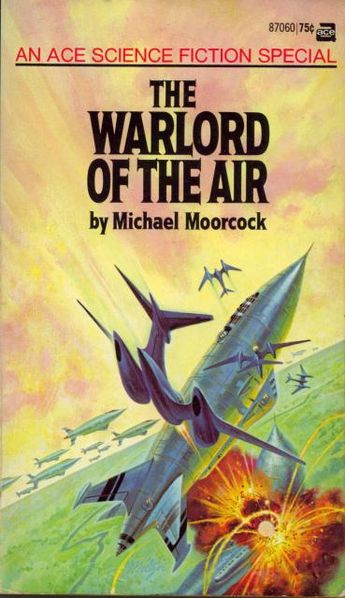
Warlord of the Air by Michael Moorcock

One of the earliest novels that can be considered Steampunk is its proper sense was Michael Moorcock's 1971 novel Warlord of the Air. The story is considered Alternate History, but has many of the same concepts that constantly appear in First-World Steampunk.

The conceit of the novel is that it was dictated by Oswald Bastable -- the main character -- to the true author's grandfather in 1903. What Warlord of the Air details is Bastable's adventures in an alternate version of 1973, where the First World War never happened and the great colonial powers never lost their empires. The story begins with Bastable's experiences in North East India in 1902 during an expedition to deal with Sharan Kang, a high priest at the temple of Teku Benga in a region of India that's supposed to be rife with magic and supernatural powers.

Not to put too fine a point on it, Bastable is shunted into an alternate version of 1973, where zeppelins rule the skies and the great empires of history dominate their spheres of influence still. Bastable at first marvels at the seeming utopias of Britain, Europe, Japan, and the United States, and the peace and tranquility that dominates the world for those great empires. However, he quickly discovers that the reason the world of the empires is so peaceful is through the colonial domination of other nations -- "the Indian starves so the Briton may feast" (94).

Bastable is horrified by the imperialist domination he witnesses, which eventually leads him to ally with a group of anarchists who are seeking to destroy the empires. In our own world, the First World War served to bankrupt Tsarist Russia and other old colonial powers, which allowed for many of the colonial possessions to gain their freedom. Since the alternate world of Warlord of the Air didn't experience the First World War with the (relatively) tame weapons of 1914-1918, the war that Bastable and his anarchist allies end up instigating between the empires is devastating. Bastable himself witnesses the atomic bombing of Hiroshima, Japan by the anarchists and is overcome by his part in the deaths of millions of innocent people.

The atomic blast knocks Bastable free from the new world, and he wakes up in 1903 (but not his own 1903), where he meets the narrator of the framing story. By this point, Bastable is already addicted to opium to deal with his experiences and the sense of dislocation he has from being shunted between two alternate worlds. The novel ends with Bastable mysteriously disappearing; there's a "postscript" by Michael Moorcock detailing his "grandfather's" death on the Western Front in 1916.

Warlord of the Air deals a lot with the themes of colonialism and racism, and the theory that this is what could happen if the First World War didn't happen when it did. And yet, to not notice the political subtext of the story (and its commentary on colonialism) is to miss much of the point of the story. Mike Perschon (the Steampunk Scholar) brings up a very good point in his own (much better) post on this novel -- the story was written during the Vietnam War, and its choice of the eponymous Warlord's nationality may very well have much to do with the commentary Moorcock intended to make (the Warlord is Chinese).

Another point I agree with Mike on -- if this story is proto-Steampunk, there where has the political subtext and commentary gone in contemporary First-World Steampunk?