Tuesday, June 29, 2010

Deconstructing Men's Regency Clothing

The Regency era in the United Kingdom is the period from 1811 to 1837, from the time King George III was declared unfit to rule through the reign of his son, George IV, first as Prince Regent and then as King in his own right after his father's death in 1820. This is the era of Jane Austen's Pride & Prejudice and Sense & Sensibility, as well as Mary Shelley's Frankenstein and other great literature. The literature of the period isn't my focus today, however. Rather, I'd like to pull apart the common dress of an upper-crust gentleman in the wider Regency era of fashion, which actually runs from 1788 to 1825.

My focus is on the upper crust because they were the only ones who would be able to afford the latest styles coming from London or Paris. Your average drover or textile worker would be lucky to get a quality shirt and trousers handed down several levels from the lord of the nearest manor. In detailing clothing of any particular period then, the best (and really only) recourse one has is to look at images of the upper classes.

The prototype of fashion for men in the early Regency period (1797 to 1810) is one Beau Brummel. In the image at left (Jessamyn's Regency Costume Companion), Brummel wears the standard tailcoat cut without a waist seam (all Victorian coats had waist seams), and you can see approximately two inches of his cream-colored waistcoat beneath. The U-shaped way the tailcoat was cut gave the hips their distinctive shape, and also created some bunching in the coat itself, which you can see if you look closely. The sleeves, as you can see, are extraordinarily long. Modern men's shirts and jackets are worn with the cuffs touching the wrist, but these cuffs hang about half-way down the hand. The coat itself would've been made from wool, fancy bengaline, or serge, and it was only the dark blue jackets that had gold buttons. Every other color of tailcoat had buttons the same color as the fabric. Note also the M-shaped lapels of the jacket.

The waistcoat Brummel wears here extends over the pants and slightly below the edge of the tailcoat. Gentlemen's waistcoats in this period would be made of wool, linen, or silk; with a single row of buttons and sometimes sharp collars. More often than not, the waistcoat would be of a brocade or similar pattern, even though solid-colored ones did exist.

A gentleman's shirt, however, would not have a long line of buttons. Rather, there would be a single button near the collar of the shirt, and a ruffle to cover the button when it was worn. A gentleman slipped his shirt on over his head, rather than buttoning it up in the Regency period. Shirts were made from linen or cotton.

To a proper gentleman, according to Brummel, the cravat was one of the most important parts of the outfit. There were easily a dozen different ways to tie a cravat, some very outlandish indeed. The work Neckclothitania (1818) described 14 distinct ways of tying a cravat, with the specific amount of starch, type of material, and color of cloth that should be worn with each. One of these tying styles was the Oriental, which was tied thus: "The Oriental made with a very stiff and rigid cloth, so that there cannot be the least danger of its yielding or bending to the exertions and sudden twists of the head and neck. -Care should be taken that not a single indenture or crease should be visible in this tie; it must present a round, smooth, and even surface - the least deviation from this rule, will prevent its being so named. This neck-cloth ought not to be attempted, unless full confidence and reliance can be placed in its stiffness.-it must not be made with coloured neck-cloths, but of the most brilliant white. It is this particular tie which is alluded to in the following lines. 'There, had ye marked their neck-cloth's slivery glow, Transcend the Cygnet's towering crest of snow.'" (The Regency Collection).

The breeches, worn here tucked into knee-high boots, were either buckskin or nankeen (a fabric originally acquired from Nanking, China). Buckskin was definitely the more common of the two, and nankeen was generally only used for summer wear. The front of the breeches were actually a flap of fabric affixed with buttons. You can see the edge of the flap beneath the curve in the jacket if you look closely; this is in stark contrast to the fly front of today. Breeches were generally light-colored, in contrast to the darker tailcoat, and didn't become fashionable for evening wear until later in the century.

Pants would come more into vogue as the century wore on, and between 1810 and 1825 really came more into prominence, as the image at right (again from Jessamyn) of Lord Grantham shows. How can you tell that Grantham is wearing pants? Look at the height of his boots. They're mid-calf length here, as opposed to Brummel's knee-high boots. If Grantham were wearing breeches, we would be able to see the ends of the legs with boots that low.

A word about boots as well -- good leather boots were essential for the gentleman of the Regency period, even when they went into town on business. According to Jessamyn, this reliance on boots as part of proper attire is the key thing that shows the roots of Regency fashion in the riding dress of the previous century.

Lastly, there's the accessories. Leather gloves, a top hat, and a cane were the proper accessories that no gentleman would be seen around town without. An aside: you might not see it in Grantham's picture, but by the time the 1820s rolled around, the common U-shape cut on the tailcoat had more or less been replaced by a straighter cut across the torso.

One very interesting note is that no Regency gentleman of any social standing would be seen without his coat on. There's an image of Hugh Grant lounging backstage at the filming of a movie version of Sense & Sensibility with his tailcoat off. It's useful so one can get a good look at the shirt sleeves common to the Regency period, but it's something that would never ever have happened during the actual Regency period. It would be a scandal if a gentleman was seen without his tailcoat on.

Now, I can kind of tell what you're thinking. What does talking about Men's clothes in the Regency period have to with Steampunk, seeing as Steampunk is a Victorian aesthetic and not a Regency one? Well, many of today's most formal apparel still has its roots in Regency fashion, and if you have an older man in a Steampunk alternate-history story set in 1865 in England (for example), then that gentleman would probably still wear Regency-style clothing. We see even today that older generations hold on to the clothes that were fashionable when they were young. A Victorian gentleman who came of age during the Regency period might do the same.

Monday, June 28, 2010

From Natural Philosopher to Scientist

Open the 1818 novel Frankenstein and, though the very plot of the story deals with science, the eponymous Victor is never referred to as a "scientist." This isn't because of a lack of scientific theories in the novel, far from it in fact, but rather because the term itself didn't exist until nearly two decades later. Englishman William Whewell, a gifted polymath and wordsmith, coined the word in 1833, four years prior to his book History of the Inductive Sciences. Whewell was a gifted wordsmith, and in fact suggested the words "anode" and "cathode" to Michael Farraday (one of the first researchers into electricity and batteries).

Prior to Whewell's creation of the term, those few men who investigated the world around them were known as either "natural philosophers" or "men of science." Even that's stretching the definition though, as natural philosophers tended to only craft theories and not perform rigorous experiments to prove their theories. Men placed in the pantheon of scientific achievement, such as Aristotle, saw no need to test their thoughts about the world. Instead they merely crafted the theories and let them stand as is. It wasn't until Alhazen's Book of Optics, written between 1011 and 1021 C.E., that a basic form of the contemporary scientific method was even introduced.

Fast-forward to the 1500s, when Francis Bacon championed inductive reasoning -- conclusions reached by experimentation -- that Europe slowly began getting on the proverbial bandwagon. Even then, the most common form of scientific inquiry was still the deductive reasoning of Aristotle. Bacon stridently rejected the a priori (independent of experience) reasoning that the Church carried through from the ancient natural philosophers and such famous Christian thinkers as Saint Anselm and Thomas Aquinas. Instead, he focused on empirically gathering information from the natural world.
"There are and can be only two ways of searching into and discovering truth. The one flies from the senses and particulars to the most general axioms: this way is now in fashion. The other derives axioms from the senses and particulars, rising by a gradual and unbroken ascent, so that it arrives at the most general axioms last of all. This is the true way, but as yet untried."-- Francis Bacon
 Of course, Bacon's methods didn't really begin to gain traction until Robert Boyle (of Boyle's law fame) wrote his 1686 work called A Free Enquiry into the Vulgarly Received Notion of Nature. Inductive reasoning quickly gained prominence after Boyle's work, even though the sciences remained lumped together under the phrase "natural philosophy."

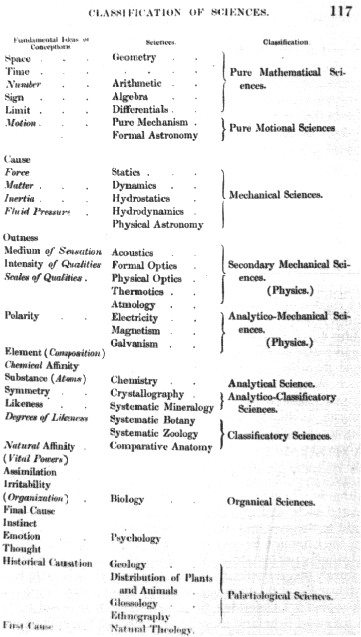
It wouldn't be until around Whewell's time that the scientific method became its modern form, and scientific investigation took on a more divided form. It was actually Whewell himself, in his Philosophy of the Inductive Sciences (1840), that classified the field of scientific inquiry into the divisions we know today. 

Whewell's classification of the sciences (from VictorianWeb.org)

This classification system, and Whewell's authorship of one of The Bridgewater Treatises, cement his place in the scientific pantheon. He also famously opposed the concept of Evolution, publishing an 1845 book called Indications of the Creator, which refuted Charles Darwin's theories.

You might perchance be wondering why this all matters to a writer of Steampunk fiction. Truth be told, it's more a matter for the writer of historical fiction set in the years before or immediately after 1833. But, seeing as a lot of Steampunk is alternate history, the fact that the word "scientist" didn't exist until Whewell came up with it is an important thing to note. You can't use the word "scientist" in a pre-1833 story because the word didn't exist then. Also, it wasn't until the 1830s that men of science began to specialize in a set discipline. In other words, it was excessively uncommon for someone to only study biology, or chemistry, or physics before Whewell's period. 

Taking this to its (somewhat) logical conclusion, the splitting of science both during and after Whewell's active period means that the writer of alternate history Steampunk needs to take care with what time frame they set their story in. Even though the story is alternate history, that's no reason to use words that didn't necessarily exist in that timeframe, unless you can come up with a very good explanation (and really, "natural philosopher" serves perfectly well for "scientist" for pre-1830s stories. Gives you the writer more freedom.).

Saturday, June 26, 2010

Changing Things Up (Yet Again)

I'm back from vacation, folks! Did you miss me?

I know I said my blog break would last a full two weeks, but I'd been sending an idea through the gears in my head while I was gone, and I wanted to get it out in the open (so to speak) as soon as possible.

Effective immediately, Tuesday posts on this blog will no longer be my Writing Thoughts. For that particular brand of musings, you'll have to visit The Secret Archives of the Alliterati every Wednesday. From here on out, you'll see all Steampunk all the time. So, without further adieu, here's my new posting schedule:

Monday: Steampunk Technology/Science/Industry
Tuesday: Steampunk Culture/Fashion/Architecture
Wednesday: Secret Archives Day
Thursday: Steampunk Books (both contemporary and classic)
Friday: Random Historical Nonsense/Whatever Comes Up

This will serve the dual purpose of focusing my blog more, and giving me a clearer idea of what the heck to post about each day in each place. Also, since Steampunk means (at least to me) the period between 1800 and 1920, you'll see a lot of posts about various real bits of history and how it's related to the genre.

Stick around for the ride. I promise I'll try to make it interesting.

Tuesday, June 22, 2010

REPOST: The Crafting of a City Map

This post originally appeared on March 23, 2010. 

My propensity for doing a lot of research is well-known across various people's blogs (and now on Twitter), but perhaps less well-known is my need to do a lot of background figuring because of this.

One of the criticisms I got from my fantabulous betas (you know who you are) was the lack of a sense of place/time differential when Moriah travels through the city of Callarion. The easiest way to fix this is to design a map of the city. However, one of the problems with doing such a thing is my lack of any drawing ability whatsoever. Instead of drawing that map then, I've decided to craft some background information on architecture and distances in various parts of the city.

This amounts to yet more research (and some unrepentant cribbing of real places) to craft the exact city map that I need in order to give the city its verisimilitude. So far, today, I've written capsules on Marketplace, Quayside, and Woodsedge (three districts of the city) and will at some point finish the ones on Lowtown, Academe, and Gardens Hill as well.

The map and geography that I'm using for Callarion borrows from three places -- Rome, San Francisco, and San Diego. San Fran and San Diego provided the proper winding coastline that I imagined, and Rome's Seven Hills provided the basis for what I kind of wanted to do terrain-wise (turns out Callarion's looking more and more like San Francisco by the minute, but that's beside the point).

What purpose does all this serve? Perhaps the biggest benefit to doing this is having a map means I don't accidentally place Thomas's shop in two different sections of Marketplace. It also means Gardens Hill consistently stays in the center of the city, and other landmarks start to gain more and more importance because they're located in a concrete place in the fictional city. Correction: the biggest benefit is that my distances stay the same. That's important, because I can't have Moriah cross Marketplace on foot at two different speeds. There lies inconsistencies my friend.

And I very much dislike being inconsistent (which is why I always like people to point out when I am). What about you, loyal blog readers? Do you craft maps of your settings? Or do you let it fly like Terry Pratchett, who's of the opinion that "You can't map a sense of humor"?

Monday, June 21, 2010

REPOST: Steampunk and Automatons

This post originally appeared on February 12, 2010.

Back in my post about cyborgs in steampunk, I mentioned that the Ancient Greeks had automatons. This is borne out by the historical record: Philo of Byzantium (3rd Century BCE) crafted an automaton maid that would pour water or wine when a cup was placed in its left hand.

The very word, automaton, is derived from the Greek word automatos -- "acting of one's own will." And, as so many cool advances that occurred in Greece during the time of the great inventors, the automatons were considered toys, religious tools to impress worshipers, or even as ways to demonstrate general scientific principles. Hero of Alexandria (who gets more press on this blog than any other inventor besides da Vinci) created siphons, a fire engine, and a programmable cart among other things as examples of his automaton skills.

There's a stanza from Pindar's Seventh Olympic Ode that refers to the island of Rhodes, well known for its proliferation of automatons:


The animated figures stand
Adorning every public street
And seem to breathe in stone, or
move their marble feet.

The Ancient Chinese also had automatons, as evidenced by this excerpt from Lie Ze:

"The king stared at the figure in astonishment. It walked with rapid strides, moving its head up and down, so that anyone would have taken it for a live human being. The artificer touched its chin, and it began singing, perfectly in tune. He touched its hand, and it began posturing, keeping perfect time...As the performance was drawing to an end, the robot winked its eye and made advances to the ladies in attendance, whereupon the king became incensed and would have had Yen Shih [Yan Shi] executed on the spot had not the latter, in mortal fear, instantly taken the robot to pieces to let him see what it really was. And, indeed, it turned out to be only a construction of leather, wood, glue and lacquer, variously coloured white, black, red and blue. Examining it closely, the king found all the internal organs complete—liver, gall, heart, lungs, spleen, kidneys, stomach and intestines; and over these again, muscles, bones and limbs with their joints, skin, teeth and hair, all of them artificial...The king tried the effect of taking away the heart, and found that the mouth could no longer speak; he took away the liver and the eyes could no longer see; he took away the kidneys and the legs lost their power of locomotion. The king was delighted."

Automatons have existed in the Middle East since the 9th Century CE, and are described in numerous texts from the time of Islamic scholarship. Al-Jazari, the famous Muslim inventor of the 13th Century, described a boat with four automatic musicians that he used to entertain partygoers. There was even an automaton duck in the 18th Century that mimicked digestion.

Suffice to say, automatons have existed for a really, really long time. What's this mean for the writer of steampunkery?

Playtime! Because the science of how to craft automatons has existed for so long, it's a well-documented method of adding robotics to your steampunk tale without applying too much modern science. Studying the texts of Signore da Vinci and those of Jacques de Vaucanson, the French inventor who crafted the aforementioned Digesting Duck, is a good start for more contemporary designs. Philo's automatic maid is well-documented via translations of his works, if you want to go more ancient.

George Mann's automatons in The Affinity Bridge are controlled via punch cards, if you want a literary example of how to do it. And The Difference Engine has an example of the Japanese Karakuri ningyō, which were designed in the 19th Century.

 A tea-serving Karakuri, designed in 19th Century Japan, with the mechanism at right. 
It functioned exactly as Philo's automatic maid did.

All you have to do, of course, is to make sure your automaton design makes sense. There's little worse than crafting some awesome technological advance and having it fall flat because the design isn't logical. 

Thursday, June 17, 2010

REPOST: The Affinity Bridge by George Mann

This post originally appeared on May 13, 2010.

The Affinity Bridge by George Mann can easily be called a blend of Urban Gothic, Detective Fiction, and Scientific Romance into the milieu that becomes Steampunk. Mann, who is the head of a major British SF/Fantasy publishing imprint, takes tropes from each of the three aforementioned genres, and has a grand old time twisting them into one mystery after another.

Sir Maurice Newbury and Miss Veronica Hobbes, his brilliant assistant, are charged with the tracking down of an escaped automaton, the investigation of a series of strangulations attributed to a glowing policeman, and oh yes, the plague of revenants ravaging London's slums.

Newbury himself is a detective in the vein of Sherlock Holmes -- brilliant, logical, fascinated by the new steam technology spreading around England, and slightly addicted to drugs. Of course, the Holmes enthusiasts among us will correct me that Holmes wasn't actually addicted. He merely experimented.

The story itself is in 1901 London, with airships and other steam-powered and mechanical innovations spreading quickly around the nation. Queen Victoria is kept alive by a rudimentary life support device of bellows and mechanical workings, and is still very much in the thick of the action. Newbury acts on her orders and hers alone -- as an agent of the Crown he goes where the Empire wills him to go. And Hobbes follows behind him, partially to help, but also to make sure Newbury remains a loyal servant.

The "affinity bridge" of the title is a link that allows for transference of a human consciousness from a living person into one of the story's ubiquitous automatons. Newbury and Hobbes uncover the secret behind this act in a factory belonging to some automaton makers, who are also connected to the plague revenants (zombies). We have Urban Gothic from the fog of the slums and the "hidden city" therein, the Detective Fiction piece from Newbury and Hobbes' investigations, and the Scientific Romance from the dark use of technology in the form of the affinity bridge.

Perhaps the most interesting thing about this novel is that it ends up being very Victorian in language and grammar. It's a fascinating choice for Mann to make, and one that actually ends up working quite well when you get into the swing of the novel. Mystery, action, science, and a breakneck pace ... what more could you want?

Tuesday, June 15, 2010

REPOST: Originality

This post originally appeared on November 25, 2009. Is it still plagiarism if I copy myself?

"Good writers borrow from other writers. Great writers steal from them outright." -- Sam Seaborn, The West Wing Season 4, Episode 2 "20 Hours in America."

One of the banes of the writer's existence is the push to produce something that is fresh, new, and original. Some people actively try to write something truly original, and in fact purposely avoid anything even close to what they're attempting to compose.

I can't think of any artist (of any stripe) working in a vacuum that can produce something accessible to the general populace. Even the great epics of ancient history -- Gilgamesh, The Iliad, the creation of myths of Scandinavia and other nations to name a few -- came from rich oral traditions of these same stories. The Iliad and the Odyssey were even spoken for decades before someone wrote them down.

No worthwhile art, I feel, is "original" in the purest sense of the word, i.e. that nothing like it ever came before. Mozart, Stephen King, Archimedes of Syracuse, Leonardo da Vinci, and other artistic and scientific luminaries of the past how-ever-many thousand years of human history all had influences from somewhere. And yet we call the greatest among us "original thinkers."

Why is that?

Because they had the ability to synthesize what was available into something new. Leonardo da Vinci took concepts that already existed in the Renaissance and used them to design his inventions. Archimedes developed weapons of war that held back the Romans through experimentation and study. Stephen King's Dark Tower series was, by his own admission, based off a viewing of Sergio Leone's The Good, The Bad, and the Ugly. And Mozart composed some of his most famous music -- The Marriage of Figaro among that -- while at court in Vienna, where he was exposed to other composers.

This process, synthesizing our influences, is how we create original works. Everything we write is influenced by something else. Accept that, and you'll be better equipped to make a story that shines with the one original element you possess.

You.